
Resource: Late Hokusai: Thought, Technique, Society

Those who are interested in art history or just a fan of early modern painting and prints can explore Late Hokusai: Thought, Technique, Society, an online bilingual research project centered on situating the artist Hokusai (1780-1849) in his social and historical contexts through his work. According to the site, the project takes the Roger Keyes collection of Hokusai’s prints held at the British Museum as its launching point, aiming understand

first, how Hokusai’s art was animated by his thought and faith; second, how Hokusai’s mature style synthesized and redefined the diverse artistic vocabularies he had mastered earlier in his career, and how we can combine stylistic and seal analysis to help identify Hokusai’s genuine oeuvre; and finally, how Hokusai’s work was enabled by the networks that linked him to collaborators, pupils, patrons, and the public.

A large project team of scholars and specialists, including affiliates of the British Museum, School of Oriental and African Studies, Freer Gallery of Art and Arthur M. Sackler Gallery have built this project to examine in-depth the various prints, drawings, and illustrated books that comprise Hokusai’s body of work.

The site is presently divided into three main sections under “Material,” including “Catalogue Raisonee,” “Bibliography, and “Illustrated Book.” The Catalogue section includes an extensive digital database formed from Catalogue Raisonné of the Single-Sheet Colour Woodblock Prints of Katsushika Hokusai (1760-1849), a resource compiled by Roger Keyes and Peter Morse. While the original contains thousands of photographs and this database is only a text version, this digitized resource includes the multitude of notes and detailed information on each image, making it an invaluable resource. As the site states:

In addition to basic data, description and ascribed date of each print, Keyes lists and describes a sequence of numbered ‘states’, based on the relative degree of block damage observed in the outlines of the finished prints. Keyes also list and describes, where known, later ‘copies’ (facsimile reproductions), which started to be made in Japan from the 1880s, using recut blocks.

Those who wish to prepare for (or perhaps cannot visit) the actual collection will find this catalogue a useful guide to its content.

The Bibliography section contains a huge collection of written resources for researchers compiled into three different sections. The first contains an annotated bibliography (originally published in 1992) of writings on ukiyo-e that date back to 1886. To supplement this list, there is also a select bibliography that is more updated than 1992, stretching to the year 2016. These bibliographies are primarily English-language resources, but the final bibliography is a list of Hokusai-related articles from Ukiyo-e geijutsu (International Ukiyo-e Society, Tokyo, Japan) that traces Japanese scholarship from 1962 to 2015. Casual and serious researchers alike will find plenty of materials here to delve deeply into the study of Hokusai and Edo-period prints.

The final portion of the website is “Illustrated Book,” another database (regularly updated) that provides an online database of almost all of the illustrated books of Hokusai. The Hokusai Project website says the following of Hokusai’s books:

Hokusai designed illustrated books throughout his career, beginning in his teens and continuing until a few months before his death.  These books spanned several genres, from popular novels (kusazôshi and yomihon), through poetry collections (kyôka ehon), to teaching manuals for aspiring artists (edehon) – as well as perhaps his greatest achievement in print, One Hundred Views of Mt Fuji (Fugaku hyakkei).  Although not as well-known as his single-sheet prints, the majority of Hokusai’s work as a print designer went into his illustrated books, which are a testament to his extraordinary ability to bring the world to life on the page.

The database itself has multiple search options and returns digitized images of the books that are open-access for viewing and include Japanese transcriptions of the woodblocks’ text. There is an “English mode” for both the search interface and each individual object’s interface, so users will find it easy to navigate.
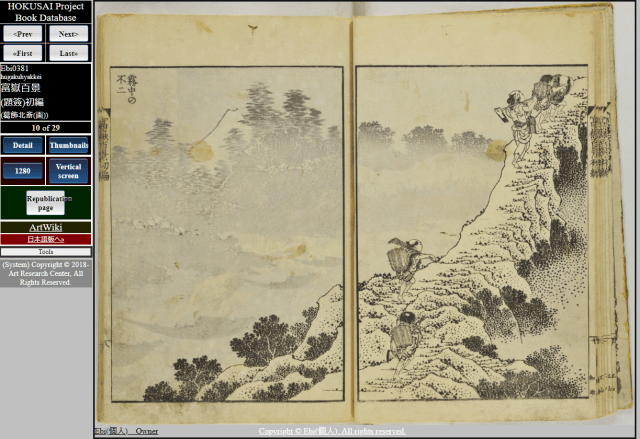
Interface for object viewing.

Whether a casual enthusiast or a research, there’s much to explore in the Late Hokusai project in both English and Japanese, so dive right in to the databases and get viewing!


Posted in blogs, culture, graduate school, main posts, study tools, undergraduate, useful links | Tagged , , , , , , , , , | Leave a comment

Job Opening: Postdoctoral/Post-MFA position in Asian Digital Film Production, Hamilton College

For details, see https://www.h-net.org/jobs/job_display.php?id=57038

The Asian Studies Program at Hamilton College invites applications for a two-year postdoctoral/post-MFA position in Digital Film Production, effective July 1, 2019. As part of the College-wide curricular emphasis on digital and experiential learning, the Program seeks a filmmaker with experience in narrative or documentary production in or on Asia. A successful candidate will teach three courses a year on topics related to digital filmmaking and use of digital technologies in humanities. Applicants should have completed Ph.D. or MFA by the time of appointment and possess a demonstrated commitment to excellence in creative production and teaching. Mastery of a relevant Asian language is expected. The successful candidate will be appointed to the Asian Studies Program with possible affiliation with another department or program. The annual salary is $50,000 with $5000 for research for the candidate with Ph.D. or MFA in hand. Application deadline is October 5, 2018.

Website: http://www.hamilton.edu

Posted in announcements, job openings, jobs | Tagged , , , , , , , , , | Leave a comment

Funding Opportunity: Rotary Yoneyama Scholarship 2018

money-150-2

Type: Undergraduate and Graduate (international students at Japanese universities)

Application deadline: 15 December 2018 1:00P.M. Japan time for both April and fall (September/October) 2019 Enrollment.

Japanese Level: N4+

Rotary Yoneyama Scholarship for applicants residing abroad is for overseas students scheduled to enroll in a Japanese university / graduate school. All Rotary International District in Japan will open for 2019 enrollment.

Applicants are expected to have Japanese language proficiency: to understand basic Japanese: JLPT N4 level.

Applicants have to find out and apply for Japanese universities / graduate schools by themselves before applying for this scholarship. And those who enroll in undergraduates are requested to submit a copy of the application for admission for the university / graduated school. Those who enroll in graduate schools are requested to submit a recommendation letter from a supervisor / professor of the applicants’ targeted graduate school.

  • Announcement of Selection Results:
    Notification of selection results are made by email at the following times: Middle of February 2019.
    *If the applicant is rejected for admission to the issuing university / graduate school, they will lose eligibility for the scholarship at that point.
  • Scholarship:
    For April enrollment: Scholarship payment begins in April 2019
    For fall enrollment: Scholarship payment begins in October (or September) 2019
    (1)Undergraduates                    100,000 yen per month
    (2)Master’s students                  140,000 yen per month
    (3)Doctoral students                  140,000 yen per month
    *Research students are not eligible.
  • Supplemental for Airfare:
    A single one-way-airfare-to-Japan is reimbursed at orientation, after arrival in Japan. Successful applicants must submit documentation showing the one-way-airfare-to-Japan. Only the economy class fee is covered.

*This scholarship is not full-covered, so tuition and enroll fee can NOT be paid by us.
*The application guideline is judged based on the one written in Japanese.

For full details and to apply, visit the website.

Posted in announcements, financial assistance, funding, graduate school, undergraduate | Tagged , , | Leave a comment

Funding: Japan Foundation Japanese Studies Fellowship for Doctoral Candidates

JAPANESE STUDIES FELLOWSHIP PROGRAM

This program provides support to outstanding scholars in the field by offering the opportunity to conduct research in Japan.

4-12 months of dissertation research in Japan for students in the humanities and the social sciences. Applicants must be ABD by the beginning of the fellowship.

US citizens and permanent residents: apply through Japan Foundation New York Office, deadline November 1.

Non-US citizens currently residing in the US apply directly to Japan Foundation Headquarters in Tokyo, deadline December 1.

For more information see: https://www.jfny.org/japanese_studies/fellowship.html

Posted in announcements, funding, graduate school | Tagged , , , , , | Leave a comment

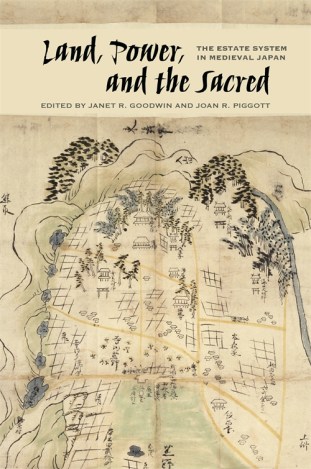
Book Announcement: Land, Power, and the Sacred: The Estate System in Medieval Japan

Land, Power, and the Sacred: The Estate System in Medieval Japan
Edited by Janet R. Goodwin, Joan R. Piggott

Landed estates (shōen) produced much of the material wealth supporting all levels of late classical and medieval Japanese society. During the tenth through sixteenth centuries, estates served as sites of de facto government, trade network nodes, developing agricultural technology, and centers of religious practice and ritual. Although mostly farmland, many yielded nonagricultural products, including lumber, salt, fish, and silk, and provided livelihoods for craftsmen, seafarers, peddlers, and performers, as well as for cultivators. By the twelfth century, an estate “system” permeated much of the Japanese archipelago. This volume examines the system from three perspectives: the land itself; the power derived from and exerted over the land; and the religion institutions and individuals that were involved in landholding practices.

Chapters by Japanese and Western scholars explore how the estate system arose, developed, and eventually collapsed. Several investigate a single estate or focus on agricultural techniques, while others survey estates in broad contexts such as economic change and maritime trade. Other chapters look at how we learn about estates by inspecting documents, landscape features, archaeological remains, and extant buildings and images; how representatives of every social stratum worked together to make the land productive and, conversely, how cooperative arrangements failed and rivals battled one another, making conflict as well as collaboration a hallmark of the system. On a more personal level, we follow the monk Chōgen’s restoration of Ōbe Estate and his installation of a famous Amida triad in a temple he built on the premises; the strategies of royal ladies Jōsaimon’in, Hachijōin, and Kōkamon’in as they strove to keep their landholdings viable; and the murder of estate official Gorōzaemon, whose own neighbors killed him as a result of a much larger dispute between two powerful warrior families.

Land, Power, and the Sacred represents a significant expansion and revision of our knowledge of medieval Japanese estates. A range of readers will welcome the primary source research and comparative perspectives it offers; those who do not specialize in Japanese medieval history but recognize the value of teaching the history of estates will find a chapter devoted to the topic invaluable.

https://www.uhpress.hawaii.edu/title/land-power-and-the-sacred-the-estate-system-in-medieval-japan/


Posted in announcements, culture | Tagged , , , , , , , , , , , | Leave a comment

Fun Link Friday: Portraits of samurai

I’ve been majorly guilty of neglecting our Fun Link Friday posts, being busy this last month running the medieval komonjo workshop here at Michigan, but as the summer winds down I’m starting to catch up on my blogging duties! So here’s a quickie Fun Link Friday for you all.

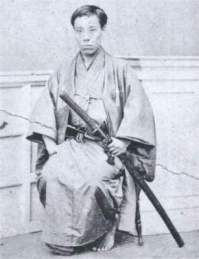
The Mice Times of Asia recently did a compilation post of rare portraits of Japanese warriors, which is a fun little glimpse into the history of Japan at the turn of the nineteenth century. While the little bit of text with the photos has some historical points I’d nitpick and the photos don’t seem to have credited sources, they’re still an interesting peek into some of the early portraiture of warriors you’ll see floating variously around the web. Take a break from your Friday web surfing and have a look!

Posted in culture, fun links | Tagged , , , , , , | Leave a comment

Job Opening: Library of Congress, Research Assistant, Foreign Affairs

  • Closing Date: August 17, 2018
  • LC Organization Unit: Congressional Research Service
  • Minimum Salary: $56,233.00
  • Maximum Salary: $73,105.00
  • Availability: U.S. Citizens Only

The Congressional Research Service (CRS) Foreign Affairs, Defense, and Trade Division (FDT) is seeking three limited-term Research Assistants to support a broad range of research tasks in three distinct sections in FDT. The relevant sections are Foreign Policy Management & Global Issues; Middle East & Africa; and Asia. The selectees will support research analysts and managers in addressing congressional requests for information and analysis by performing research, data analysis, writing, and other research support duties as assigned by section and division management.

Ideal applicants will have experience conducting research in one or more of the following areas, as well as some knowledge of the legislative and policy contexts, institutional dimensions, and policy tools related to such issues:

  • Foreign policy, including global trends and transnational issues.
  • Regional foreign policy issues pertaining to the Middle East, North Africa, and Sub-Saharan Africa.
  • Regional foreign policy issues pertaining to the Asia-Pacific region, including South Asia.

Successful candidates must be able to work as part of a collaborative team and must exhibit the intellectual flexibility and broad research skill set that facilitate effective work across a wide issue spectrum beyond the applicant’s research focus or concentration.

Strong research, writing, and presentation skills are essential; candidates with both qualitative and quantitative research skills, and experience using data visualization to inform research products and processes, are especially urged to apply. CRS works exclusively for the United States Congress, providing policy and legal analysis to committees and Members of both the House and Senate, regardless of party affiliation. As a legislative branch agency within the Library of Congress, CRS has been a valued and respected resource on Capitol Hill for more than a century. CRS is well known for analysis that is authoritative, confidential, objective, and nonpartisan. Its highest priority is to ensure that Congress has immediate access to the nation’s best thinking on public policy issues of interest to its Members and Committees.

https://www.loc.gov/item/careers/research-assistant-foreign-affairs-vacancy-var000538/

Posted in announcements, job openings, jobs | Tagged , , | 1 Comment

Resource: Japanese Children’s Literature: A History from the International Library of Children’s Literature Collections

Japan’s National Diet Library (NDL) has a ton of digitized resources in both English and Japanese. So much so that sometimes it’s easy to forget how many of those resources have been curated into mini-exhibitions or databases geared toward specific things in their collection. The International Library of Children’s Literature (ILCL) is one of those special subsections that showcases some of the great material the NDL holds.

The International Library of Children’s Literature serves as a national library for children’s literature, aiming to acquire and make publicly available all such materials. One of the features of their website is an online exhibition entitled “Japanese Children’s Literature: A History from the International Library of Children’s Literature Collections,” which actually emerged from an exhibition once held in the museum section of the library.

Now made digitally available, the Japanese Children’s Literature section of the site follows the emergence of modern children’s’ books in Japan beginning in the Meiji period (1868-1912) and moving through several different periods of history, including pre- and post-war, the bubble era, leading up to the ‘90s, and the 21st century.

The readings examined are not just books, but magazines, cultural and musical guides, and more. There are English-language explanations of each work that touch on their formats, content, and cultural significance. As their site states, “Children’s literature reflects the time periods they were published in ―social conditions, sense of values and how children were represented in the society,” meaning this exhibition provides an interesting peek into each period of history displayed.

The books are all a part of the ILCL collection, and many on the site have been digitized to provide full access to their content. Want to know a little more about the cultural and historical circumstances of growing up in modern Japan? Be sure to check out the International Library of Children’s Literature’s site!

Posted in culture, graduate school, main posts, study tools, undergraduate, useful links | Tagged , , , , , , | Leave a comment

Job Opening: tenure-track position in Japanese Studies, The Hebrew University of Jerusalem

The Hebrew University of Jerusalem invites applications for a tenure-track position in (open rank) in Japanese Studies in the Department of Asian Studies. The position is open to all candidates who have attained a Ph.D. degree or to advanced graduate students who expect to be granted their Ph.D. no later than July 1, 2019.

Job requirements:

The position is open for all fields of Japanese Studies. Candidates must exhibit the ability to conduct high-quality academic research which draws on Japanese-language sources. Knowledge of other Asian languages is an advantage.

The position is open to individuals who hold a doctorate degree and for advanced doctoral students whose Ph.D. will be conferred no later than July 1, 2019.

Responsibilities include the teaching of required and elective courses in the candidate’s field(s) of specialization (at B.A. and M.A. degree levels). Successful candidates are expected to conduct independent and original research at the highest academic level, demonstrate academic leadership, compete for Israeli and international research grants and have the ability to cooperate with colleagues within the Faculty of Humanities and beyond.

Where pertinent and in accordance with inter-departmental needs, a joint departmental appointment or teaching sharing arrangement may be considered, combining with one of several departments and cognate areas of study in the Humanities.

The Hebrew University’s main language of instruction is Hebrew. Nonetheless, the possibility of teaching one or more graduate courses in English may be entertained. Candidates whose Hebrew proficiency is such that they would not be comfortable teaching in Hebrew will be encouraged to master the Hebrew language sufficiently during the initial years following their appointment.

Qualified candidates will be invited for a campus visit, which will include a job talk, an interview and meetings with department members.

For additional details, please contact the department chair, Dr. Orna Naftali, at orna.naftali@mail.huji.ac.il, or the Head of the Japan Section of the Department of Asian Studies, Prof. Nissim Otmazgin, at nissim.otmazgin@mail.huji.ac.il

Further information about the Department of Asian Studies can be found at the following website: http://en.asia.huji.ac.il

Posted in announcements, job openings, jobs | Tagged , , , , | Leave a comment

Happy 8th birthday, Shinpai Deshou!

Photo by John Liu.

Wowee! It’s been 8 years, everybody! Who can believe it? Happy birthday!

I know things have slowed down a little here as I finish up my degree and balance a zillion projects, but I hope to continue bringing everybody helpful articles and resources for a long time yet!

Enjoy the warm weather and have a piece of cake for Shinpai Deshou! 🎂


Posted in site maintenance | Tagged , | 2 Comments