Funding: ACLS Fellowships and Grants in Buddhist Studies 2018-19

The American Council of Learned Societies (ACLS) invites applications in the 2018-19 competition year of The Robert H. N. Ho Family Foundation Program in Buddhist Studies. In cooperation with the Foundation, ACLS offers an integrated set of fellowship and grant competitions supporting work that will expand the understanding and interpretation of Buddhist thought in scholarship and society, strengthen international networks of Buddhist studies, and increase the visibility of innovative currents in those studies.

Dissertation Fellowships: one-year stipends to PhD candidates for full-time preparation of dissertations

Postdoctoral Fellowships: two-year stipends to recent recipients of the PhD for residence at a university for research, writing, and teaching

Research Fellowships: one-year stipends for scholars who hold a PhD degree, with no restrictions on time from the PhD

Grants for Critical Editions and Scholarly Translations: one-year stipends for the creation of critical editions, translation of canonical texts, and translation of scholarly works

New Professorships: multi-year grants to colleges and universities to establish or expand teaching in Buddhist studies

These are global competitions. There are no restrictions as to the location of work proposed, the citizenship of applicants, or the languages of the final written product. Applications must be submitted in English. Program information and applications are available at www.acls.org/programs/buddhist-studies/.

Deadline for submission of fellowship applications: November 14, 2018.

Deadline for institutional applications for New Professorships: January 9, 2019.

For more information, please email BuddhistStudies@acls.org.
Posted in announcements, funding, graduate school | Tagged , , , , | Leave a comment

Fun Link Friday: Miniature Bonsai Sculptures

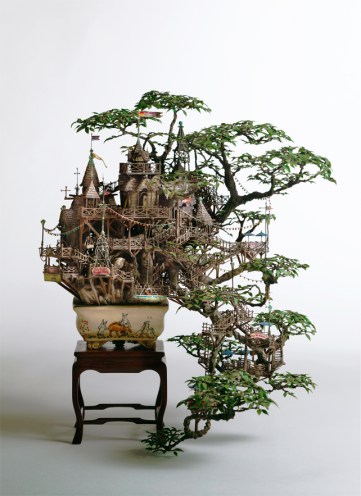
Photo by Takanori Aiba.

In the past we’ve featured some neat Friday features on bonsai, like magnetic tree bases for your favorite trees or bonsai in space, and this week there’s even more fun to be had!

Forbes recently featured the Japanese artist Takanori Aiba, who carefully crafts the shape of bonsai trees through traditional growing techniques to create playful, tiny worlds unto themselves.

Pairing the trees with models and miniatures, each work becomes its own imaginative space that tells a unique narrative. Both the works themselves and Aiba’s explanation of the process are fascinating, so be sure to check out a large number of works on Aiba’s website and Forbes’ full piece.

Happy Friday!


Posted in culture, fun links | Tagged , , , , , | 1 Comment

Resource: Okinawa Collection at GWU

The George Washington University in Washington DC recently became (as far as I know) the second major university in the United States, and the first on the US mainland, to establish a separate Okinawa Collection within the university libraries.

Since its establishment in 2015, the Okinawa Collection has, of course, only continued to grow, under the expert guidance of Japan/Okinawa specialist librarian Mitsuyo Sato. It includes a wide range of materials and resources, both hardcopy and digital, on topics ranging from the history of the pre-annexation Ryukyu Kingdom to more modern political, economic, and social matters.

The Okinawa Collection’s website includes a number of research guides on specific topics or themes within Okinawan Studies, a list of Okinawa-related institutions and organizations around the world, and a page for the Collection’s own news & events.

But the real resource is not the website so much as the Collection itself, if you have the opportunity to visit in person in DC!

Posted in graduate school, main posts, undergraduate, useful links | Tagged , , , | Leave a comment

Job Opening: Japanese Lecturer, Emory University

For details, see https://www.h-net.org/jobs/job_display.php?id=57171

The Department of Russian and East Asian Languages and Cultures (REALC) at Emory University in Atlanta, GA seeks a full-time lecturer in Japanese language and culture to begin Fall 2019.  This is a three-year renewable position pending positive reviews.  It is a professional career track position with possibility of promotion.  Applicants should hold a Ph.D. in Japanese pedagogy, linguistics, or a closely related area (ABD and in rare cases MA will be considered) and possess native or near-native proficiency in Japanese and English in addition to successful college teaching experience.  Familiarity with new technologies in teaching and with methods of assessment are desirable.  Teaching load is 5 courses per academic year.  The candidate will be expected to teach courses in Japanese language and culture based on his or her qualifications and to take a leadership role in program development.  Scholarly exchange is promoted among faculty in our department, which includes the programs in Chinese, Japanese, Korean, and Russian.  We also collaborate with the East Asian Studies Program and a range of other programs.

Website: http://realc.emory.edu

Posted in announcements, job openings, jobs | Tagged , , , , | Leave a comment

Funding: Marilynn Thoma Fellowship in Spanish Colonial Art

For those working on interactions between Japanese and the Spanish Empire, especially in the field of art history, the Thoma Foundation offers two fellowships: one for short research travel, and one for lengthier fellowship support.

The Marilynn Thoma Fellowship provides unrestricted funding in the amounts of $45,000 for pre-doctoral dissertation research and $60,000 for post-doctoral research, and is the first portable, unrestricted fellowship devoted exclusively to Spanish Colonial art. International scholars are encouraged to apply.

In concert with the new Fellowship, the Thoma Foundation is pleased to announce its inaugural Research and Travel Awards in Spanish Colonial art. Awards of up to $15,000 are available to independent scholars and advanced graduate students completing MA or PhD dissertations to help defray the costs of research-related expenses.

Applications must be submitted by October 15, 2018.

For more information, and the online portal for applying, see: https://thomafoundation.org/announcing-the-marilynn-thoma-fellowship-in-spanish-colonial-art/

Posted in announcements, funding, graduate school | Tagged , , , , | Leave a comment

Fun Link Friday: Early Sound & Video Footage of Japan

This week is a quick Fun Link Friday, as I don’t have much info on the origins of these audiovisual materials. These videos have been making their rounds lately, and so far as I can tell people have taken them to be authentic. The first below is a series of short clips that include early sound footage of Kyoto from around 1929. Take a listen and hear everyday street rumbles, musical performances, and festival sounds.

Similarly, though the audio track has been artificially added to this second, earlier clip (distributed by the EYE Filmmuseum) shows footage of Tokyo from 1913-1915. It’s amazing to see the throngs of people and the details of everyday dress.

Take a look and enjoy a peek into these early views of modern Japan!

Posted in culture, fun links | Tagged , , , , , , , , , | Leave a comment

Book Announcement: The Economic and Business History of Occupied Japan: New Perspectives

The Economic and Business History of Occupied Japan: New Perspectives

The Occupation era (1945-1952) witnessed major change in Japan and the beginnings of its growth from of the ashes of defeat towards its status as a developmental model for much of the world. The period arguably saw the sowing of the seeds of the post-war flowering of what some term the ‘Japanese economic miracle’. However, some scholars dispute this position and argue that the Occupation’s policies and impacts actually hindered Japan’s recovery. This volume addresses this question and others surrounding the business and economic history of this crucial period.

The chapters presented in The Economic and Business History of Occupied Japan are authored by major scholars of the Occupation from the U.S., Japan, and Europe. The chapters are divided into three sections: ‘Planning, reform and recovery’, ‘Industries under the Occupation’, and ‘Legacies of the Occupation era’. Following an introduction focusing on the historiographical background, the first section examines zaibatsu dissolution and its significance, the role of Japanese businessmen within the Occupation’s reforms, the crucial impact of Japan’s postwar Materials Crisis, and the impact of reform at the local level in Hokkaidō. Part two looks at a number of individual industries and their development during the era, including the fishing, automotive, and cotton spinning industries. The final section looks at the human impact of the changes of the initial postwar years, including the reintegration of repatriates into the Japanese labour force and the impact of changing working patterns on society and family life.

This book covers a key period of the economic and business history of Japan and presents numerous new approaches and original contributions to the scholarship of the Occupation era. It will be of interest to scholars of modern Japan, economic history, business history, development studies and postwar U.S.-Japan relations.

Table of Contents

Introduction – Thomas French

Part 1: Planning, Reform, and Recovery

  • Japanese Agency and Business Reform in Occupied Japan: The Holding Company Liquidation Commission and Zaibatsu Dissolution – Steven J. Ericson
  • Japan’s Postwar Social Metabolic Crisis – Mark Metzler
  • The Role of the Frontier: GHQ’s Economic Policies and Hokkaidō – Juha Saunavaara

Part 2: Industries under the Occupation

  • An Empire Reborn: The Japanese Fishing Industry during the Occupation – William M. Tsutsui
  • Fiats and Jeeps: The Occupation, Jeeps, and the Postwar Automotive Industry – Thomas French
  • The Japanese Cotton Spinning Industry and Economic Recovery under SCAP – Takahiro Ohata

Part 3: Socioeconomic Changes in the Occupation Era

  • The Economic Reintegration of Former Colonial Residents in Postwar Japan – Steven Ivings
  • Good Wife, Wise Mother and Americanised Consumer: The Forced Social Democratisation of the Private Sphere in Occupied Japan – Zsombor Rajkai

Publisher’s page:

https://www.routledge.com/The-Economic-and-Business-History-of-Occupied-Japan-New-Perspectives/French/p/book/9781138195899

Posted in announcements, culture | Tagged , , , , , , , , | Leave a comment

Call for Papers: Mechademia: Second Arc, vol 13.1: Queer(ing)

CFP: Mechademia: Second Arc, Vol. 13.1: Queer(ing), guest ed. James Welker (due 1 June 2019; published spring 2020)

Japanese manga, anime, and games culture is associated with excessive sexuality and gender-bending that have unsettled cultural norms in multiple, often queer, ways. The appeal of such queer(ing) and hypersexual attributes have at least partially driven the spread of these media and fan practices around Asia and beyond. In spite of the ongoing strong association with Japanese popular culture, however, Japan is but one of multiple centers of queer(ing) media and fan practices in contemporary Asia.

This issue of Mechademia: Second Arc will focus on queer(ing) comics, animation, and games, and other related media as well as their fandoms in Asia. The editors invite papers of 5000 to 7000 words which offer new insights on queer aspects of popular media and fandoms, or alternatively new queer(ing) perspectives on media and practices that are not self-evidently queer. Possible topics include but are not limited to:

—Asian media and fandoms and intersectional queer studies
—Fujoshi and fudanshi fan cultures
—Boys love/yaoi, and slash media
—Yuri/girls love, and femslash media
—Representations of queer identities (transgender, intersex, bisexual, pansexual, gender-fluid/genderqueer/nonbinary/X-gender, asexual, lesbian, gay, etc.)
—Queer(ing) pornographies (“hentai,” tentacles/“consentacles,” BDSM/fetish media, etc.)
—Queer(ing) fan practices (crossplay, maid cafes, butler cafes, etc.)
—Flows of queer(ing/ed) media and fandom practices around Asia

Mechademia: Second Arc is now published twice a year by University of Minnesota Press. More on the journal, including the Mechademia style guide, can be found at Mechademia.net.

The deadline for submission of complete manuscripts is 1 June 2019, with expected publication in spring 2020.

Posted in announcements | Tagged , , , , , | Leave a comment

Fun Link Friday: Rice paddy art of Inakadate 2018

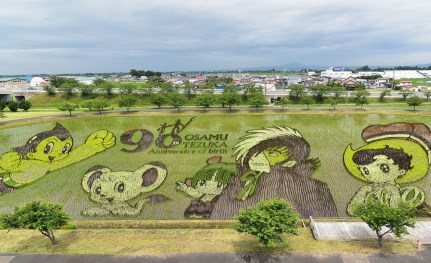
Every year when I remember that Inakadate in Aomori prefecture has new rice paddy art for us to enjoy, I get excited all over again! Each summer they pick new themes and create dramatic, beautiful images from variations of white, purple, and brown rice. This year they did a famous scene from the American film Roman Holiday as well as an homage the world-renowned Japanese artist Tezuka Osamu.

Check out more pictures of the rice paddies, including daily photographs of the rice growing in and a live feed from Inakadate’s official website!

Posted in culture, fun links | Tagged , , , , , , , , | 1 Comment

Job Opening: Assistant Professor in Modern and Contemporary Japanese Literature and Cultural Studies

Indiana University – Bloomington, East Asian Languages and Cultures

Assistant Professor in Modern and Contemporary Japanese Literature and Cultural Studies

The Department of East Asian Languages and Cultures in Indiana University’s School of Global and Interantional Studies invites applications for a tenure-track position as assistant professor in modern and contemporary Japanese literature and cultural studies. The successful candidate will be able to work across arts and humanities disciplines and have expertise in one or more of the following areas: modern and contemporary Japanese literature, film, popular culture, and media studies. We especially encourage those scholars to apply whose work cuts across genres and media. The successful candidate will contribute to the undergraduate and graduate programs of the department.

Deadline: November 10

For details, see https://www.h-net.org/jobs/job_display.php?id=57091

Website: https://ealc.indiana.edu/

Posted in announcements, job openings, jobs | Tagged , , , , , , , | Leave a comment