Job Opening: Tourism & Hospitality (Asia), rank open (tenure-track)

Institution: Ritsumeikan Asia Pacific University, College of Asia Pacific Studies
Position:  Professor, Associate Professor, Assistant Professor, Non-Tenure Track, Tenure Track, Tourism and Hospitality
Location:   Japan

APU is located on Kyushu, Japan’s traditional gateway to all of Asia.

There are currently 99 countries and regions represented in our student body. APU is an innovative and global community educating future leaders in the Asia Pacific region and beyond. We are looking for faculty members excited about teaching in this multi-cultural setting.

Positions:
Tourism and Hospitality Fields

Employment Conditions:
Academic appointment, rank and salary dependent upon qualifications of candidates. Employment package includes bonus, housing and transportation allowances.

Application Process:
All required documents should be submitted by post to the University

Application Deadline:
July 15, 2011

For detailed recruitment information and application instructions, please visit the following page:

http://www.apu.ac.jp/home/modules/news/article.php?storyid=1207

For further inquiries, please contact us at:

frecruit (at) apu.ac.jp
Subject: “Application for (field name) Position”

Contact Info:

APU Academic Office, Ritsumeikan Asia Pacific University,
1-1  Jumonjibaru, Beppu, Oita 874-8577 JAPAN

Posted in announcements, job openings, jobs | Tagged , , , , , , , , , , | Leave a comment

CAJLE Annual Conference 2011: Exploring on Pedagogical Japanese Grammar and Teaching for Communication

Theme: Exploring on Pedagogical Japanese Grammar and Teaching for Communication
Conference Date:  August 5 (Fri)-7 (Sun), 2011
Conference Venue:  University of Regina

The annual conference of the Canadian Association for Japanese Language Education (CAJLE) will be held at University of Regina in Saskatchewan from Friday, August 5, through Sunday, August 7, 2011.

This conference will gather together teachers of the Japanese language and academics in related fields from institutions around the world.

The conference will consist of paper presentations, as well as a keynote speech by Professor Hisashi Noda (Osaka Prefecture University) and workshops by Professor Noda, Professor Mutsuko Endo Hudson (Michigan State University), and Professor Hiroko Kataoka (California State University, Long Beach).

Please visit the website http://cajle.info/cajle2011_annual_conference for details. Early-bird registration will end on Thursday, June 30.

We aim at gathering together Japanese language teachers from all levels of institutions around the world to explore this theme from a variety of perspectives. We wholeheartedly welcome everybody and look forward to seeing you in Regina where the horizons are endless.

If you have any further inquiries, please contact us at cajle2011@gmail.com

Posted in announcements, conferences, graduate school | Tagged , , , , , , , , | Leave a comment

Fun Link Friday: Saying Hello From Beyond the Grave

Fun but maybe a bit macabre, there have been a number of articles on the topic of QR codes being used in cemeteries in Japan since as early as March 2008, when the memorial stone maker Ishinokoe announced its decision to begin offering codes embedded in their gravestones. With Japan’s reputation for pushing the envelope with technology and the popularity of cell phones and QR code usage there, it may seem somehow unsurprising to hear of the rising popularity of this memorial feature. But a recent story on NPR suggests that this concept may be taking off in the West, too.

So what is a QR code? A QR code, or “Quick Read” code, is a small two-dimensional square much like a bar code that is featured on anything from magazines and food items to business cards and clothes. Scan a given QR code with you cell phone and you’ll be forwarded to a website that has its address is encoded in the design.

How are these QR codes being used in Japan for people who have died? As the video report below (Japanese only) shows, people are setting up QR codes with websites containing images and information about their loved ones on the memorial stone markers. Just whip out your cell phone during your visit to the deceased and scan the QR for their personal site that’s been set up with photos, text, or any other related media by loved ones, providing the viewer with an instant connection to the dead. Relatives can view the number of hits the grave gets, and visitors can also sign the website after they’ve visited like a guestbook. As the crunchgear.com article states: “The mourners can also access information about who paid a visit to the grave recently, get the deceased person’s profile and other data or set up a virtual grave.”

Of course, in the age of unavoidable technology, maybe it shouldn’t be shocking that you can’t even escape the internet after you’re dead. Is an uploaded and updatable web presence a good way of honoring the deceased? Is death depersonalized by the web or does the ability to constantly check hits on a guestbook site provide closure?

In the West, too, this trend is catching on. In May NPR ran an article on a Seattle-based company called Quiring Monuments that’s started to introduce QR codes as well. There’s no mention in the article as to whether the head of this company originally got the idea from the Japanese companies pioneering this idea of living on through technology three years ago, but clearly this is the direction the age of cell phones and living through the web is moving. See the Quiring Monuments advertisement for this service (in English) below.

A great way to honor the dead or another creepy way for the internet to invade us (beyond the grave)? You decide!

Posted in culture, fun links | Tagged , , , , , , | 2 Comments

Job Opening: Orchestral Studies Administrative Associate

More information and online application at HigherEdJobs.com.

Institution: Stanford University

Location: Stanford, CA

Type: Part-Time/Adjunct

The Department of Music is seeking an Orchestral Studies Administrative Assistant supporting the Director of Orchestral Studies. This is an on-going, 50% FTE, benefits-eligible position.

This position reports to the Director of Orchestral Studies and provides administrative support for him. The work includes scheduling, public relations, contracting ringers for concerts, budget creation and tracking, production assistance for the Pan-Asian Music Festival (in Winter Quarter each year), supervising student workers, and general administrative support. The work is fragmented, so the ability to be detail-oriented and proficient in office software is important.

Completed work is reviewed periodically for appropriateness and conformance with established policies.

QUALIFICATIONS: Experience as an orchestral or other musical ensemble performer or in arts management is required. Polished written communication skills in English (for press releases and grant applications) required. Ability to read music and or interest in/experience with Asian cultures a plus. Flexibility in personal schedule for events management on an occasional basis required.

Posted in announcements, job openings, jobs | Tagged , , , , , | Leave a comment

Job Opening: Assistant Program Director for Education Abroad

From HigherEdJobs.com. Apply online here.

Institution: Virginia Tech
Location: Blacksburg, VA

Review of applications will begin on 6/23/2011; however, applications may be received until a candidate is appointed.

About Virginia Tech
Virginia Tech’s Education Abroad program sends more than 1,200 students overseas annually in a range of programs. The office provides counseling for both students and parents in financial aid, credit transfer, and how to fit Education Abroad into a four-year college plan that may already seem tight. In any given year, Virginia Tech students study abroad in as many as 48 countries.

Position Summary
The Assistant Program Director for Education Abroad (ADEA) reports to the Program Director for Education Abroad (PDEA). This position will provide leadership, management and direct support for Virginia Tech’s Education Abroad (EA) program in OIRED. It will execute and provide coordination and supervision of: faculty-led, exchange and affiliated programs for overseas study, informational training resources for faculty-led overseas programs, pre-departure orientations, educational programs, recruitment and marketing for education abroad. It is a regular full-time, calendar year, administrative and professional faculty position.

RESPONSIBILITIES:

RECRUIT and MARKET international education programs:

* Plan and execute campus-wide exhibits and fairs.

* Maximize value of EA website in collaboration with PDEA and Web Designer.

* Supervise student employees.

* Prepare, maintain and distribute education abroad handbook.

* Design and implement campus media communications program; prepare and distribute articles. Publicize, schedule and lead information programs in residence halls, in classrooms, and for other campus events such as Parents’ Weekend, new student orientation, and recruitment fairs.

* Create and implement training workshop for academic advisors.

CAMPUS RELATIONS:

* Assist with faculty led programs as directed by the PDEA, including making necessary logistical arrangements, coordinating with onsite staff, and advising students about program details.

* Actively serve as a resource for faculty and staff who wish to learn more about EA.

RELATIONS WITH OTHER PARTIES: develop and maintain good relations between EA and other parties:

* Serve as Bilateral Exchange Program Placement Officer, reviewing all outgoing exchange applications and placing students at appropriate universities in an effort to address their needs, university expectations, and the maintenance of exchange balances.

* Serve as official Coordinator for the International Student Exchange Program.

STUDENT ADVISING:

* Serve as primary supervisor of student Peer Advisors.

* Advise students on selecting and preparing for education abroad experiences; correspond with international partners and non-VT programs as appropriate regarding student applications and procedures; assist students as appropriate with necessary forms and payments.

* Serve as primary Scholarship Advisor for Gilman, Freeman-Asia and National Security Education Program (NSEP) scholarships

* Collaborate with PDEA and staff to provide assistance to inbound exchange students. Examples include correspondence before arrival and arrangements for housing & meal plans.

ORIENTATION PROGRAMS & PROMOTIONAL MATERIALS:

* Collaborate with PDEA on design, planning and facilitation of pre-departure orientation, re-entry programs and all related, written material.

* Prepare, plan, and lead workshops for faculty wishing to lead programs abroad.

* Schedule and lead all pre-departure orientations for faculty-led education abroad programs.

* Create and maintain all VT-specific resource materials for the Education Abroad Advising Library.

SPECIAL PROJECTS & OTHER:

* Develop, maintain and distribute emergency plans for EA.

* Search, identify and prepare in collaboration with OIRED team education abroad grant proposals.

*Create and develop an EA Alumni Association.

* Serve as OIRED representative to VT orientation team (O-Team).

* Recruit and organize volunteer returned study abroad participants for special programs.

* Oversee arrangements for visits of representatives from education abroad programs and international universities.

* Assist in the development of a handbook for exchange program faculty.

* Other projects as identified.

* Support grant proposal development activity and assist with administration of sponsored funded activities.

Required Qualifications

*Masters in Communications, Extension, International Affairs, International Education or relevant degree.

* Significant experience in education abroad/international education.

* Significant experience in international curriculum and program development.

* Experience studying, living or working abroad.

* Excellent interpersonal and management skills.

Preferred Qualifications
* Excellent communication skills with demonstrated experience with public speaking and presentations.

* Fluency in at least one foreign language.

* Experience in writing grant proposals for expanding resource base.

Employment Comments
For Additional information about this position, please contact:

Dr. S.K. De Datta, Associate Vice President for International Affairs,

Search Committee Chair

Virginia Polytechnic Institute and State University

526 Prices Fork Road, Mail Code 0378

Blacksburg, VA 24061

(540) 231-2162

If hired, applicant must furnish proof of U.S. citizenship or appropriate visa.

How to Apply for this Job
Apply online at http://www.jobs.vt.edu search using posting# 0110570.

Online application is required and the following supporting

documents are also required:

(1) Cover letter.

(2) Resume.

(3) Names, addresses, telephone numbers and email addresses of at least three professional references.

(TIP: Have these documents ready to attach at the time you submit your application; the system will not allow you to enter a second time for any position)

Note: Official transcript for highest degree earned will be required prior to the start of employment.


Posted in announcements, job openings, jobs | Tagged , , , , , | Leave a comment

Resource: Japanese Performing Arts Resource Center

If you’re researching, teaching, or simply a fan of Japanese performance arts, whether it’s Noh, kyōgen, or kabuki, then the Japanese Performing Arts Resource Center (JPARC) is an excellent way to find both basic and advanced information on a variety of topics. Administered as a part of GloPAC, the Global Performing Arts Consortium, JPARC is funded by grants from a number of foundations and moderated by contributing performance art scholars. JPARC includes sections for the analysis of certain topics, multimedia articles, and reference materials such as glossaries, bibliographies, browsing indexes, and timelines.

The wealth of information and the variety of mediums it uses is incredible. In fact, I’m almost at a loss as to how to approach discussing the content, because there’s just so much of it in so many areas that it’s difficult to know where to begin. Something that’s probably helpful to start with is to look at the Using JPARC section, which offers some helpful videos about how to navigate content on the site.

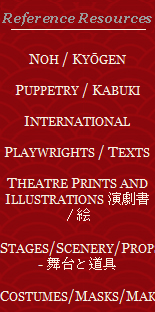
At its most basic navigation, JPARC is divided into Noh/Kyōgen, Puppetry/Kabuki, International, Playwrights/Texts, Theatre Prints and Illustrations, Stages/Scenery/Props, and Costumes/Masks/Makeup. Obviously, this covers a huge amount of ground. Not only that, but these sections all have several subsections of information individualized based on the art. For example, if we click on “Noh/Kyōgen,” we find seven more areas that include everything from performance history to a virtual Noh stage. This link leads to even more content, with diagrams of the stage, an interactive 3D tour of a Noh stage, and scrolling tour of the backstage area. Each section is handled differently depending on the content, so although you have these more interactive features in the noh section, for kabuki there’s video guides as well as full articles. Also, as you browse these pages, if you’re not familiar with the terminology being used, for example, if you’re clueless as to what a hashigakari is, the words are presented as links to glossary pages that have a wealth of information and images referring to the technical language.

Another benefit to JPARC is that all the images used originate from the GloPAD database, so anything you click you can find more information on. For example, if I’m in the Puppetry/Kabuki section and I click on an image that says “puppet manipulation” I’m immediately taken to the GloPAD database, which features all of the image’s info, including who’s in the picture, what it’s a picture of, the year, the performance, the place, and even the collection responsible for the picture. JPARC itself also has glossaries for each section (such as this one on puppetry and also has great multimedia features, like these audio clips of jōruri narrations of puppet plays.

The Bibliography section is another incredibly useful feature for those doing research, as it’s divided into “Translations” “Noh” “Puppetry” “Kyogen” “Kabuki” and “Other” and can be filtered by author, term, piece translation, performing art, year, title, OR type. So it’s excellent for browsing or looking up a specific item of interest. What’s also great is that filters are also done with links- so you don’t just browse by these broad categories blindly, but can click a specific person or title to get more materials through that filter.

The wealth of information on this site is staggering, and I couldn’t possibly touch on all of the articles, interviews, translations, glossaries, and multimedia resources included on the site in a single article. The sheer volume of content and the ability to cross-reference materials in numerous ways makes the Japanese Performing Arts Resource Center an unparalleled resource for the study of Japanese performance arts in the English language. If you have a serious or even passing interest in Japanese theatre, I highly recommend you lose yourself for a couple hours in the JPARC site and check out some of the fantastic materials they have to offer. Happy browsing!

Posted in culture, fun links, graduate school, study tools, undergraduate, useful links | Tagged , , , , , , , , , , , , | 5 Comments

Job opening: Full time translation coordinator

Translation company in Shimbashi, Tokyo seeks full-time translation coordinator.

Intac Co., Ltd. (http://www.intac.co.jp) is currently seeking a translation coordinator. The position is full-time and will be based at our office in Shimbashi, Tokyo starting at the end of July. Tasks will include liaising with clients and freelance translators, editing/proofreading of translated materials, budget control, schedule management, translation, and more.

The ideal candidate will be a native speaker of English with excellent speaking and writing skills, and a thorough working knowledge of Japanese (JLPT level 1 or equivalent) – excellent Japanese reading comprehension will be expected. Previous editing and/or translation experience is highly desirable. Candidates must be comfortable working with computers and file creation software, e.g. Microsoft Office, etc. Good workplace communications skills are also a must: the candidate will be expected to work closely with our international staff in a Japanese office environment to meet deadlines and produce high quality translations. Salary will be commensurate with experience.

Working visa required; applications will only be accepted from those currently residing in Japan. If interested, please send a cover letter in both English and Japanese along with your resume. Applicants will be asked to take a translation and editing test. Only successful applicants will be contacted. Send application materials to recruit.english@intac.co.jp.

For twenty years, Intac Co., Ltd. has provided clients with a comprehensive range of multilingual services to assist in their product localization strategy. Intac’s services cover a broad range of multilingual communication: text translation for brochures, press releases, advertising copy, video games, company reports; the selection and recording of native voices for promotional videos, video games, commercials; and DTP design and production of instruction manuals, posters, and product packages.


Posted in announcements, job openings, jobs | Tagged , , , , , , | Leave a comment

Fellowship: The Wilson Center

http://www.wilsoncenter.org/index.cfm?fuseaction=Fellowships.welcome

The Center awards approximately 20-25 residential fellowships annually to individuals with outstanding project proposals in a broad range of the social sciences and humanities on national and/or international issues. Topics and scholarship should relate to key public policy challenges or provide the historical and/or cultural framework to illuminate policy issues of contemporary importance.

Themes
The Center devotes significant attention to the exploration of broad thematic areas.

Primary themes are:

  1. governance, including such issues as the key features of the development of democratic institutions, democratic society, civil society, and citizen participation;
  2. the U.S. role in the world and issues of partnership and leadership—military, political, and economic dimensions; and
  3. key long-term future challenges confronting the United States and the world.

While the Center does not engage in formulating actual policy, priority will be given to proposals related to these themes and intersecting with crucial public policy issues. Within this framework, the Center also welcomes projects that provide the historical and/or cultural context for some of today’s significant public policy debates.

The Project Proposal
It is essential to make your project clear to individuals outside your own field and to explain its broader implications. The elements requested below should be incorporated into the text:

  1. a detailed description of the topic and its importance beyond the interests of the specific field of study;
  2. the originality of the proposed study (explain what makes the project distinctive);
  3. the basic ideas and hypotheses;
  4. the methodology to be used (including the activities you will undertake to gather the data you need for your project and the techniques that you will use to analyze the data in order to prove your thesis);
  5. the present status of your research, including how much has already been done in relevant collections and archives, and what you would hope to accomplish at the Center;
  6. the materials that will be used, the importance of Washington-area resources, and the need for residency at the Center;
  7. the relevance of the project to contemporary policy issues. (It is essential to include this element.)

Eligibility

  • Citizens or permanent residents from any country (foreign nationals must be able to hold a valid passport and obtain a J1 Visa)
  • Men and women with outstanding capabilities and experience from a wide variety of -backgrounds (including government, the corporate world, professions, and academia)
  • Academic candidates holding a Ph.D. (Ph.D. must be received by the application deadline of October 1)
  • Academic candidates demonstrating scholarly achievement by publications beyond their doctoral dissertations
  • Practitioners or policymakers with an equivalent level of professional achievement
  • English proficiency as the Center is designed to encourage the exchange of ideas among its fellows

Ineligibility

  • Applicants working on a degree (even if the degree is to be awarded prior to the proposed fellowship year)
  • Proposals of a partisan or advocacy nature
  • Primary research in the natural sciences
  • Projects that create musical composition or dance
  • Projects in the visual arts
  • Projects that are the rewriting of doctoral dissertations
  • The editing of texts, papers, or documents
  • The preparation of textbooks, anthologies, translations, and memoirs

Notes on Eligibility
You do not need an institutional affiliation to apply. For most academic candidates, a book or monograph is required. Scholars and practitioners who previously held research awards or fellowships at the Wilson Center are not precluded from applying for a fellowship. However, the nature and recency of the prior award may be among the factors considered during the selection process, and by the Fellowships Committee of the Board of Trustees.

If you have questions regarding your eligibility or the suitability of your project, please e-mail the Scholar Administration Office at fellowships@wilsoncenter.org.

Selection Process
Fellowships are awarded on a competitive basis. External interdisciplinary panels of distinguished scholars and practitioners assess the applications. The panels’ recommendations are presented to the Center’s Fellowships Committee of the Board of Trustees, composed of public officials who serve ex officio, citizens appointed by the President of the United States, and citizens from the private sector. The Fellowships Committee of the Board of Trustees makes the final decisions on selection.

The basic criteria for selection are:

a) significance of the proposed research, including the importance and originality of the project;
b) quality of the proposal in definition, organization, clarity, and scope;
c) capabilities and achievements of the applicant and the likelihood that the applicant will accomplish the proposed project;
d) the relevance of the project to contemporary policy issues.

The Center welcomes in particular those projects that transcend narrow specialties and methodological issues of interest only within a specific academic discipline. Projects should involve fresh research-—in terms of both the overall field and the author’s previous work. It is essential that projects have relevance to the world of public policy, and fellows should want, and be prepared, to interact with policymakers in Washington and with Wilson Center staff who are working on similar issues.

Fellows’ Responsibilities
The Center’s “scholars in residence” are so in both name and fact. Fellows are expected to work from their offices at the Center and to participate in appropriate meetings organized by the Center. Fellows are also expected to present their research at our informal internal Work-in-Progress seminars, and to attend the Work-in-Progress presentations given by their colleagues. In addition, fellows are encouraged to make a more formal presentation to the public such as a colloquium, seminar, workshop, or other form of meeting. The Center expects all fellows to seek ways to share their expertise with the Washington policy community. The form of such interaction could range from a deep background briefing for an executive branch agency to an informal roundtable discussion with members of Congress and their staffs.

Affiliation at the Center
Fellows in residence will be affiliated with one of the Center’s programs/projects. Program and project directors often collaborate with scholars in designing seminars, conferences, and/or meetings related to scholars’ research. As of August 2010, these include the United States Studies Division and the International Security Studies Division and programs on Africa, Asia, Brazil, Canada, Eastern Europe, Latin America, Mexico, the Middle East, Russia and the former Soviet Union, Southeast Europe, and Western Europe; and the program on Science, Technology, America, and the Global Economy and projects on Comparative Urban Studies, Congress, Environmental Change and Security, Science and Technology, Global Health, History and Public Policy (which includes the Cold War International History Project and the North Korea International Documentation Project), and Leadership and Building State Capacity.

Facilities and Services
Each fellow is assigned an office available to him or her every day around the clock. The Center is located in the heart of Washington, D.C., and includes conference rooms, a reference library, and a dining room. The building is a smoke-free environment. The Wilson Center Library provides access to digital resources, its book and journal collections, and to the Library of Congress, university and special libraries in the area, and other research facilities. Windows-based personal computers are provided, and each fellow is offered a part-time research assistant. Although fellows are responsible for locating their own housing in the Washington, D.C. area, the Center provides written materials to help facilitate the search process.

Stipend
The Center tries to ensure that the stipend provided under the fellowship, together with the fellow’s other sources of funding (e.g., grants secured by the applicant and sabbatical allowances), approximate a fellow’s regular salary. Stipends provided in recent years have ranged from $26,000 to $85,000 (the maximum possible). Stipends include round trip travel for fellows. If spouses and/or dependent children will reside with the fellow for the entire fellowship period, money for their travel will also be included in the stipend. In addition to stipends, the Center provides 75 percent of health insurance premiums for fellows who elect Center coverage and for their accompanying family members.

Length of Appointment
Fellows are expected to be in residence for the entire U.S. academic year (early September through May, i.e., nine months), although a few fellowships are occasionally awarded for shorter periods with a minimum of four months. The Center does not award fellowships for the summer months (June, July, August). Fellowships cannot be deferred, and extensions into the summer months have not been possible in recent years.

Deadline for Applications
The Center holds one round of competitive selection per year. Fellowship applications must be postmarked or submitted online by October 1. Applicants are notified of the results of the selection process in March of the following year.

Instructions for Applicants

The Application

You may apply either online or by mail.
A complete application must include the following:

  1. the two-page, single-sided Fellowship Application Form;
  2. a list of your publications that includes exact titles, names of publishers, dates of publication and status of forthcoming publications (not to exceed three pages);
  3. a Project Proposal (not to exceed five single-spaced typed pages, using 12-point type); The Center reserves the right to omit from review applications that are longer than the requested page length;
  4. a bibliography for the project that includes primary sources and relevant secondary sources (not to exceed three pages);
  5. the one-page Financial Information Form.

If you are mailing your application, in addition to the original, please submit ten collated and unstapled copies of items #1, 2, 3, and 4. Pages must be one sided. Please do not send sample publications.

All application materials must be submitted in English. Applications submitted via fax machine will not be considered.

Posted in announcements, financial assistance, funding, jobs | Tagged , , , , , , , , , , , , | Leave a comment

Job opening: Women Researchers in Japanese Philosophy or Culture

The Faculty of Humanities of Kyushu University in Japan is now actively recruiting academic women researchers for the “Women Researchers Promotion Program”, according to its policy of “Supporting Positive Activities for Female Researchers” This program is based on the “Supporting Positive Activities for Female Researchers Program” by MEXT (Ministry of Education, Culture, Sports, Science and Technology) and is financially supported by Kyushu University. After being selected by the Faculty of Humanities, the candidate will be required to pass a secondary screening by the Research Strategy Committee of Kyushu University. The allowances are based on pay scales relevant to a Professor, Associate Professor, Lecturer, or Assistant Professor at Kyushu University.

Application deadline: August 5, 2011

For details see: http://www.srp.kyushu-u.ac.jp/wrpb23_home/e-lit.pdf

Posted in announcements, culture, job openings, jobs | Tagged , , , , , , , | Leave a comment

Call for Papers: International Journal of Tantric Studies (IJTS)

We are seeking academics and bona fide scholars to write and submit finished papers and review papers to our scholarly online publication (established 1995), the *International Journal of Tantric Studies* http://asiatica.org/ijts/.

The IJTS is open to all bona fide scholars in Hindu and Buddhist Tantric and Tantra-related studies, translations and translators in Sanskrit, Bengali, Vernacular, Tibetan, Chinese, Japanese, etc. We are looking for articles that engage any aspect of this broad theme.

Before submitting your paper / paper review, please read our Submission Guidelines: http://asiatica.org/asiatica/submit /.

We plan to publish all the IJTS papers in hard copy shortly. Depending on the next issue, hopefully by the end of the year.

*IJTS editors: Enrica Garzilli (Editor-in-Chief), Michael Witzel (Managing Editor), Roberto Donatoni, Minoru Hara, David N. Lorenzen, Benjamin Prejado, Michael Rabe, Debabrata Sensharma, Karel van Kooij.

For recent papers see http://asiatica.org/ijts/

Send proposals to Enrica Garzilli: garzilli@asiatica.org

Dr Enrica Garzilli
Asiatica Association, IJTS & JSAWS
http://asiatica.org/

Posted in announcements | Tagged , , , , , , | Leave a comment