Job Opening: World/Asian history, Idaho State University

The Department of History at Idaho State University seeks applicants for a tenure-track, assistant professor position who can teach courses in world and Asian history, with research emphasis in either field. The position is based at ISU’s Idaho Falls campus, and the time period of specialization is open. We seek candidates who demonstrate a growing record of scholarship, commitment to effective teaching, and potential for successful grant funding. This assistant professor will contribute to the existing undergraduate and graduate curricula and develop courses in their areas of specialization. Teaching duties in a 3/3 load include in-class, broadcast, and online formats. Student advising is essential. The successful hire, whose office will be based on the Idaho Falls campus, will be a full member of the History Department, which delivers degree programs to both Idaho Falls and Pocatello.

Website: https://isu.edu/history/

For details, see URL: https://www.h-net.org/jobs/job_display.php?id=57895

Posted in announcements, job openings, jobs | Tagged , , , , , , | Leave a comment

Job Opening: Postdoctoral Research Assistant/Associate in Japanese Studies, University of Cambridge

The Department of East Asian Studies, within the Faculty of Asian and Middle Eastern Studies at the University of Cambridge, is seeking to appoint to a 3-year, fixed-term postdoctoral research associate post in Japanese Studies. The post will start in September 2019 and last until August 2022. We are open to any speciality within Japanese Studies but preference will be given to candidates whose research and teaching interests complement those of the current staff. We also welcome applications from candidates who embody our “Japan and the World” campaign and with an interest in comparative studies in relation to the rest of East Asia.

Website  http://www.jobs.cam.ac.uk/job/19459/

Posted in announcements, job openings, jobs | Tagged , , , , , | Leave a comment

Funding: Tanaka Fund Grant to Support Promising Junior Japanese Studies Scholars

Historical Background

The Tanaka Fund was established in 1974 as the result of an exchange of gifts between the governments of Canada and Japan. Canada offered $1,000,000 to Japan to promote Canadian studies in Japanese universities, while Japan provided 300 million yen for the enhancement of Japanese studies in Canadian universities. The funds were used to establish the “Japan Foundation Trust Fund for the Promotion of Japanese Studies in Canadian Universities”. Guidelines developed by The Japan Foundation stipulated that the Trust Fund would be administered as an endowment and that the income thereof should be made available for the support and promotion of Japanese studies at universities and colleges in Canada. Universities Canada has administered the Fund since 1975. Until 2016, support for Japanese language lectureship at Canadian Universities was funded. In 2018, the Tanaka Fund was restructured to focus support towards young emerging scholars in order to foster the next generation of Japanese Studies scholarship in Canada.

Universities Canada and the Japan Foundation, Toronto are pleased to announce the call for applications for the 2018 Tanaka Fund Grant to Support Promising Junior Japanese Studies Scholars.

Annual Value: A total of $30,000 is available for this year’s awards.
Value of Grants Masters or Doctoral level students at Canadian Institutions: Grants up to a maximum of $10,000
are available

Duration: A maximum of three months in Japan

Eligibility:

  1. Open to Canadian citizens or permanent residents only.
  2. Doctoral or Master’s level students who:
    • are enrolled in a Canadian university;
    • are conducting research related to Japan (comparative research included) with methods in the humanities and social sciences;
    • will have completed the necessary course work before undertaking activities funded by this award;
    • find it necessary to visit Japan to complete their thesis or dissertation.
  3. Master’s students who are doing research towards their master’s thesis.
  4. Doctoral students who are doing research towards their dissertation proposal.
  5. PhD candidates are NOT eligible.
Contact Email:
Posted in announcements, funding, graduate school | Tagged , , , , , , , | Leave a comment

Book Announcement: Unbinding the Pillow Book: The Many Lives of a Japanese Classic

Unbinding The Pillow Book
The Many Lives of a Japanese Classic

Gergana Ivanova

An eleventh-century classic, The Pillow Book of Sei Shōnagon is frequently paired with The Tale of Genji as one of the most important works in the Japanese canon. Yet it has also been marginalized within Japanese literature for reasons including the gender of its author, the work’s complex textual history, and its thematic and stylistic depth. In Unbinding The Pillow Book, Gergana Ivanova offers a reception history of The Pillow Book and its author from the seventeenth century to the present that shows how various ideologies have influenced the text and shaped interactions among its different versions.

Ivanova examines how and why The Pillow Book has been read over the centuries, placing it in the multiple contexts in which it has been rewritten, including women’s education, literary scholarship, popular culture, “pleasure quarters,” and the formation of the modern nation-state. Drawing on scholarly commentaries, erotic parodies, instruction manuals for women, high school textbooks, and comic books, she considers its outsized role in ideas about Japanese women writers. Ultimately, Ivanova argues for engaging the work’s plurality in order to achieve a clearer understanding of The Pillow Book and the importance it has held for generations of readers, rather than limiting it to a definitive version or singular meaning. The first book-length study in English of the reception history of Sei Shōnagon, Unbinding The Pillow Book sheds new light on the construction of gender and sexuality, how women’s writing has been used to create readerships, and why ancient texts continue to play vibrant roles in contemporary cultural production.

https://cup.columbia.edu/book/unbinding-the-pillow-book/9780231187985

Posted in announcements, culture | Tagged , , , , , , , | Leave a comment

Funding: Robert and Lisa Sainsbury Fellowships

Robert and Lisa Sainsbury Fellowships provide recipients with an opportunity to work in a scholarly environment conducive to completing a publication project. The Fellowships are available to academics who have received a PhD in any area of Japanese culture. Preference will be given to Early Career Researchers working in the fields of visual studies, including but not limited to history of art, cultural heritage, archaeology, architecture, film studies, and digital humanities. During their appointment Fellows are encouraged to contribute to our Third Thursday Lecture Series and to organise a symposium in Norwich. They may also contribute to the Japan Research Centre Seminar Series at SOAS. Fellowships are one year (preferred option, value of £24,000, start date September 2019) or six months (value of £12,000, start date subject to negotiation). Fellows will be given shared office space and are expected to live in Norwich during their appointment. A good level of spoken and written English is required, and application documents should be completed in English.

Further details and application form can be found on our website: http://sainsbury-institute.org/fellowships/robert-and-lisa-sainsbury-fellowship/ If you have any queries please email us: sisjac@sainsbury-institute.org

Posted in announcements, job openings, jobs | Tagged , , , , , , , | Leave a comment

Resource: The Meiji at 150 Project

Today we introduce a wonderful, multifaceted and multi-year project spearheaded by the University of British Columbia that has been bringing great content to the Japanese Studies community in a number of forms: The Meiji at 150 Project.

In honor of the 150th anniversary of Japan’s Meiji Restoration in 1868, UBC launched a series of events, including a Meiji at 150 Lecture Series that brought numerous scholars to their campus (there are youtube videos of many of these lectures on the site!) and a Workshop Series that invited interdisciplinary students and faculty in Japanese Studies to consider different methods and topics in the study of modern Japanese history.

While the larger website provides tons of information on the entire project and these individual events on their page, for those that were not of UB or in the Vancouver area, they have also created two incredible online resources for the study of Meiji Japan and its global connections.

Image from Meiji at 150 Digital Resources page (click to access).

The first is the Meiji at 150 Digital Teaching Resource. This part of the site provides a series of “visual essays” that takes advantage of the collections of UBC’s library. Prints, maps, paintings, and photographs are paired with historical narratives and analyses to help contextualize these rare archival items. You can find topics that vary as widely as Canadian missionaries to Japan in the late nineteenth to early twentieth centuries to “brocade pictures” that featured the apparel of Meiji women, pointing to how Japan was linked to global textile markets. These open-source teaching materials offer fresh and visually exciting ways to access this period of Japan’s past.

In this second one can also find a Digital Resources link that compiles much of these special collections into discrete categories alongside related projects, such as their collections of Tokugawa Period maps (linked to a distribution timeline!) or their Geomapping of Vancouver’s Japantown using archival photographs. There’s a lot of incredible materials to be found here that show how successfully the project has sought to connect the past to the present for a broad audience.

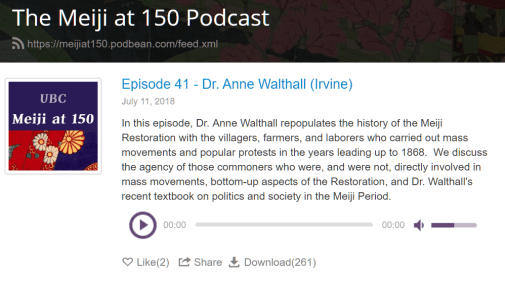
Also in that spirit, one of the highlights of the Meiji at 150 Project is their Podcast Series. From the website, the podcast is

hosted by Tristan Grunow [and highlights] the recent research and pedagogical approaches of specialists of Japanese history, literature, art, and culture. Topics covered will range from the position of the Meiji Restoration and Meiji Period in each scholar’s research, to how they view the significance of the Restoration in Japanese and global history, and finally to how they teach the Meiji Period in their classrooms. The companion Meiji at 150 Student Podcast, meanwhile, spotlights students studying Japanese history on the UBC campus.  Students discuss selected aspects of Japanese culture and share their research findings, thoughts, and passion for animemanga, food, music, literature, film, sports, and other facets of Japanese society and popular culture.

The podcast covers a wide array of topics, and their episode list breaks them down thematically, rather than by release, which is helpful for targeting specific topics for your own interest or in the classroom. You might be drawn to the Language & Literature theme, Gender,  Global Meiji, or something else—pick your favorite! Major props to the designers for also including a “how to cite” for the podcast episodes at the bottom so it’s very student-friendly.

Clicking on each episode will give you a brief synopsis, and you can either listen to the episode on the site, download it directly, or subscribe through your favorite provider.

The Meiji at 150 Project is a great example of how a huge variety of individuals can come together to create public-facing resources and make valuable contributions to our knowledge of the past and present. It’s been wonderful to watch this project unfold and continue to generate historical materials, resources, and conversations across institutions and even countries. Whether you plan on developing lessons for the classroom or just have a passing interest in Japanese history and culture, take a moment to see what the Meiji at 150 project has to offer! You can also keep up with them on their Twitter and Facebook accounts.

Posted in graduate school, main posts, study tools, undergraduate, useful links | Tagged , , , , , , , , , , , | Leave a comment

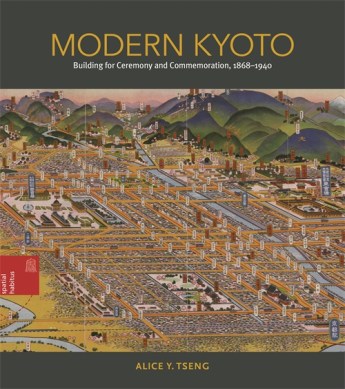
Book Announcement: Modern Kyoto: Building for Ceremony and Commemoration, 1868-1940

Modern Kyoto: Building for Ceremony and Commemoration, 1868–1940
Alice Y. Tseng

Can an imperial city survive, let alone thrive, without an emperor? Alice Y. Tseng answers this intriguing question in Modern Kyoto, a comprehensive study of the architectural and urban projects carried out in the old capital following Emperor Meiji’s move to Tokyo in 1868. Tseng contends that Kyoto—from the time of the relocation to the height of the Asia-Pacific War—remained critical to Japan’s emperor-centered national agenda as politicians, planners, historians, and architects mobilized the city’s historical connection to the imperial house to develop new public architecture, infrastructure, and urban spaces. Royal births, weddings, enthronements, and funerals throughout the period served as catalysts for fashioning a monumental modern city fit for hosting commemorative events for an eager domestic and international audience.

Using a wide range of visual material (including architectural plans, postcards, commercial maps, and guidebooks), Tseng traces the development of four core areas of Kyoto: the palaces in the center, the Okazaki Park area in the east, the Kyoto Station area in the south, and the Kitayama district in the north. She offers an unprecedented framework that correlates nation building, civic boosterism, and emperor reverence to explore a diverse body of built works. Interlinking microhistories of the Imperial Garden, Heian Shrine, Lake Biwa Canal, the prefectural library, zoological and botanical gardens, main railway station, and municipal art museum, among others, her work asserts Kyoto’s vital position as a multifaceted center of culture and patriotism in the expanding Japanese empire.

Table of contents:

Introduction
Chapter one: A new imperial garden and imperial shrine
Chapter two: Beginnings of a cultural park in Okazaki
Chapter three: Enthronements and exhibitions
Chapter four: Commemorative projects as urban landmarks
Epilogue

For more information, please see https://www.uhpress.hawaii.edu/title/modern-kyoto-building-for-ceremony-and-commemoration-1868-1940/

Alice Y. Tseng is associate professor of history of art and architecture at Boston University

Email: aytseng@bu.edu

Posted in announcements, culture | Tagged , , , , , , | Leave a comment

Job Opening: Assistant Professor of Art History and Assistant Curator of Asian Art

The School of Art at Ball State University welcomes applications for a tenure-track position at the level of Assistant Professor of Art History and Assistant Curator of Asian Art to begin August, 2019. Responsibilities include a 2/2 teaching load consisting of undergraduate art history surveys and upper-level courses in the candidate’s area of expertise. The remaining portion of the faculty member’s load is devoted to serving as assistant curator of the David Owsley Museum of Art’s collection of Asian art.

The School of Art at Ball State has forty-nine full-time faculty and offers state-of-the-art facilities serving almost 600 undergraduate majors as well as a growing graduate program. Programs at the BA, BS, BFA and MFA levels include animation, art education, art history, ceramics, drawing, glass, graphic arts management, metals, painting, photography and intermedia arts, printmaking, sculpture, and visual communication (graphic design).

Housed in the Art and Journalism building, School of Art students enjoy over 57,000 square feet of world-class facilities, a nationally ranked animation program, the Atrium Gallery, and the Glick Center for Glass. Students and faculty work closely with David Owsley Museum of Art on campus, among the finest university art collections in the nation.

Ball State University is accredited by the National Association for Schools of Art and Design.

Deadline: 2/5/2019

For more information: https://bsu.peopleadmin.com/postings/15530

Posted in announcements, job openings, jobs | Tagged , , , , , , | Leave a comment

Call for Papers: Travel and Landscape in Japanese Literature, Art, and Culture

Travel is Life, Travel is Home: Representing Travel and Landscape in Japanese Literature, Art, and Culture

April 4-6, 2019

University of Iowa, Iowa City IA

Deadline for proposals: December 10, 2018

Keynote: Meredith McKinney, visiting fellow at the Japan Center, Australian National University

In the introduction to his seventeenth-century travel diary, The Narrow Road of the Interior, Matsuo Bashō declares, in Helen McCullough’s translation, that “travel is life, travel is home.”  While the use of travel as a metaphor to express the transience of life was centuries old by Bashō’s time, the idea continues to resonate even today. The awareness of one’s environment as both the basis for and product of human experience has shaped representations of travel and landscape throughout Japanese cultural production, from Saigyō’s twelfth-century travel poetry, to Natsume Sōseki’s 1906 Kusamakura and beyond.


The interaction between humans and their environments is increasingly conceptualized in terms of mobile bodies, from observations of space as both “a product of interrelations” and a sphere of “contemporaneous plurality” (Doreen Massey 2005); to place as “the surveyor’s active involvement with the landscape” (Jeff Malpas 2009); to the paradox of “cosmopolitanisms” that simultaneously resists a stable permanent residence while adopting a plural understanding of places of origin (Robbins and Horta 2017). Instances of travel in all of its forms—for pilgrimage, official duties, tourism, military strategy, emigration, or evacuation, exile, and refuge—posit a body that moves through its environments, rather than existing as a static object. Even in the case of virtual or imagined travel, there is an emphasis on movement across space and through a succession of multiple places. Such instances of travel, represented and explored through literature, art, and performance, allow for an analysis of the ways in which humans not only conceptualize and interact with, but indeed move through their environments.


The University of Iowa Japanese Program, Center for Asian and Pacific Studies, and International Programs, with generous support from the Japan Foundation, seek papers addressing this conference’s broad themes, focusing on any period of Japanese cultural production. We are especially interested in papers that explore the themes of landscape, space, place, and travel as they are represented in literature, art, film, performance, religious history, and intellectual history or that engage relevant representations using media beyond the written word.


Please submit proposals, including name, affiliation, a paper title, and an abstract of no longer than 300 words for a 15- to 20-minute paper presentation, toKendra-Strand@uiowa.edu by December 10, 2018. Registration is free. Some funding will be available to defray travel expenses for participants.


Suggested Topics:

Travel within, through, outside of, or to Japan

Tourism and famous places

Pilgrimage, wandering, and reclusion

Official travel, exile, or statelessness

Nomadic or migrant patterns

Landscape and gender, sexuality, or the body

Virtual, imagined, or simulated travel

State or religious ideology and landscape

Authenticity, experience, and representation of landscape

Relationships between space and time

Ecological observations and processes

Impacts of technology or infrastructure upon travel practices

Posted in announcements, conferences, graduate school | Tagged , , , , | Leave a comment

Funding: 20th Century Japan Research Awards for 2018-2019

20th Century Japan Research Awards for 2018-2019

The Nathan and Jeanette Miller Center for Historical Studies and the University of Maryland Libraries invite applications for two $1,500 grants to support research in the library’s Gordon W. Prange Collection and East Asia Collection on topics related to the period of the Allied Occupation of Japan and its aftermath, 1945-1960. Holders of a Ph.D. or an equivalent degree are eligible to apply, as are graduate students who have completed all requirements for the doctorate except the dissertation. The competition is open to scholars in all parts of the world and from any discipline, but historical topics are preferred. University of Maryland faculty, staff, and students may not apply. More information can be found on the Prange Collection website.

The application deadline is December 7, 2018.  The grant must be used by December 14, 2019. Grant funds will be disbursed in the form of reimbursement for travel, lodging, meals, reproductions, and related research expenses. Such costs as computers or software are not eligible. NOTE TO NON-U.S. CITIZENS:  approximately 30% of the total award may be withheld for tax purposes, depending upon the recipient’s country of origin. The withholding may be reimbursed to the recipient after filing a tax form with the U.S. Internal Revenue Service (IRS).

All applications must be submitted electronically by attachment to millercenter@umd.edu with “Twentieth-Century Japan Research Awards” in the subject line. Applications must include a curriculum vitae and a two-to three-page description (double-spaced) of the research project. Applications from graduate students must be accompanied by a letter from the principal faculty advisor attesting to the significance of the dissertation project and to the student’s completion of all other degree requirements.

Materials in the Gordon W. Prange Collection include virtually all Japanese-language newspapers, news agency releases, magazines, pamphlets, and books dating from the period of Allied censorship, 1945-1949, in addition to over 10,000 newspaper photos.  There are also materials published by Chinese and Korean residents, most of which are written in Japanese.  Related collections in English include the personal papers of Charles Kades and Justin Williams.  Office correspondence documenting policies and decisions of the Publications, Pictorial, and Broadcast Division, Civil Censorship Detachment (Civil Intelligence Section), Supreme Commander for the Allied Powers Japan, are complementary to official Occupation records housed at the National Archives, College Park.  Japanese newspapers and magazines from the Prange Collection are available for research on microform.  The East Asia Collection contains Japanese-language books published during the wartime period, scholarly monographs on Occupied Japan, and a wide variety of reference works.

During the campus visit, the award recipient will give an informal talk on her/his research.  At the conclusion of the visit, the recipient will submit a blog post reflecting on her/his research experience that will appear on Prange Collection social media sites. Reimbursements will be made after the blog post has been submitted to the Prange Collection staff.

For further information about the collections, consult the following websites: http:/www.lib.umd.edu/prange and http://www.lib.umd.edu/EASIA/eastasia.html

Posted in announcements, funding, graduate school | Tagged , , , , , , | Leave a comment