Job Opening: Art History, Reed College

job opening - 5Institution:       Reed College
Location:          Oregon, United States
Position:          Assistant Professor of Art History

Art Historian/Art of Asia, Africa, the Middle East, or Latin America

REED COLLEGE.  Assistant Professor.  Start fall 2015.  Salary and benefits competitive.  Ph.D. or near completion.  We seek scholars whose teaching and research in the history, theory, and criticism of art and architecture exhibit a strong global perspective.  Possible areas of specialization may include Asia, Africa, the Middle East, or Latin America.  The appointment entails 1) teaching advanced art history courses in area of specialization; 2) regular teaching of a methodologically-focused introduction to art history of the instructor’s own design; 3) participation in the interdisciplinary Humanities Program; and 4) advising undergraduate art history theses.  Reed College is a small, highly selective undergraduate institution with a strong liberal arts curriculum and an emphasis on excellence in teaching and scholarship.  Reed College is a community that believes that cultural diversity is essential to the excellence of our academic program.  In your letter of application, please address how your scholarship, teaching, mentoring, and/or community service might support Reed College’s commitment to diversity and inclusion articulated in the College’s diversity statement (http://www.reed.edu/diversity/).

Please submit CV, a letter describing teaching and scholarly interests, and 3 letters of reference tohttp://apply.interfolio.com/27222.  Questions may be addressed to Dana E. Katz, chair of the search committee, atkatzda@reed.edu.

An equal opportunity employer, Reed College values diversity and encourages applications from underrepresented groups.

Deadline: December 15, 2014

Posted in announcements, job openings, jobs | Tagged , , , , | Leave a comment

Living in Japan Part 3: Apartment Hunting Basics

While my last two posts on living in Japan covered a lot of different areas for before you leave and immediately after you arrive, today, I will be talking specifically about hunting for apartments. For someone unacquainted with Japanese real estate, finding a place to live can be a frustrating experience, especially if you are trying to locate somewhere good before you even arrive. Some people therefore prefer to avoid the hassles of living in an apartment entirely, either moving into international dorms, guest houses, or share houses, etc.

BUT, all of this said, living in your own apartment is something some people just prefer and is, at times, unavoidable. So for my next two articles, we’re going to break down the apartment-hunting process, beginning with what to expect, where to start, important processes to know about, an example of initial costs, and, in the next article, a how-to guide for reading apartment listings (along with basic explanations of Japanese apartments) including a full vocabulary set and examples of online advertisements. But first: the basics.

Previous articles:

Living in Japan Part 1: Before You Arrive
Living in Japan Part 2: Getting Your Residency Started

Ready? Here we go!

Getting Started:

First off, things you will typically need to take with you to the real estate office when you actually sign for an apartment:

  • passport
  • zairyū card (see previous article)
  • hanko (see previous article)
  • guarantor
  • cell phone (recommended for filling out contact information, but not entirely necessary)
  • lots of money up front (see section on cost estimates below)

As I also previously mentioned in more detail, you will want to do the following things in preparation probably even before you arrive:

  • Do online searches for apartments in the area that you want to live.
  • Look at maps of the general area on GoogleMaps.
  • Ask friends or colleagues who are in/have been to Japan about the area you want to live in.
  • Make a best case/worst case scenario budget. (see more on this below)
  • If applicable, ask your boss or friends for their suggestions for real estate agents (especially if they are your guarantor)
  • Find a real estate agent.

N.B.: I was told by a Japanese friend that you cannot sign a contract without being physically in Japan. I’m not sure if this holds water all the time, but may be something to be aware of.

Photo by Aaron Webb

Photo by Aaron Webb

Real Estate Agents

The last point, finding a real estate agent (fudōsan不動産) can actually be done after you arrive. In my case, I had a friend who was a real estate agent who was helping me through the process, but many people just walk right into one of the many real estate offices you see littering the streets of whatever city. You can usually recognize them because they’ll have apartment advertisements plastering their windows or on big signs out front of their officers.

Generally speaking, in Japan one does not deal with landlords directly, but MUST go through a real estate agent. There will probably be a negotiation that goes on where the real estate agent first has to ask whether the landlord is willing to rent to a foreigner. In areas like Tokyo or Yokohama, which have a large foreigner population, this typically isn’t a problem, but it could be, depending on the person’s hesitancy to deal with a tenant with limited Japanese skills or any experiences they may have had with a bad foreign tenant in the past.

Be wary about real estate agents who may seem to be showing you less than respectable places. This is not, so far as I know, a typical experience, but if you feel like your agent might be showing you shadier apartments because of your foreigner status, go ahead and try a different agency, as they are common enough that you don’t need to feel tied to your first stop.

Sites to Consult

If you want to go into a real estate office very prepared with a good idea of just what it is you’re looking for (which I HIGHLY suggest), you can search online ahead of time at Japanese apartment listings. There are major sites as well as local sites for individual areas. Surviving in Japan found these to be some of the major online sites:

In addition to these big conglomerate websites, individual real estate offices also maintain their own sites you can google, and depending on where you live, you might also find local options. Since I wanted to live near Tokyo University, for example, I looked at http://todai-sumai.com/ and also checked out options through Tokyo University http://www.u-tokyo.ac.jp/ja/administration/housing-office/housing/shukusha/index.html. Be sure to ask at your university what options they have for foreign students or if they have an agency that they recommend. People will almost always have suggestions.

When you check these sites out, typically you have a number of ways you can search for what you want in a general way, selecting:

  • エリア検索 (area search)
  • 沿線検索 (rail line search)
  • 駅検索(station search)

In addition to these basic options, you might also find some like 店舗検索 (store search) for those who want to find an apartment within a certain distance of shops in an area.

It is also important to note that unless you are using a website that is specifically geared to the English language, all of your exchanges, contracts, etc. should be expected to be in Japanese. Cities with large foreign populations can be expected to have some English language businesses that can help you, although the cost of services in the end is not necessarily different. For example, here are some options suggested by A Texan in Tokyo for places to look for English-language options in the Tokyo area:

There are also English-language options to look for apartments on sites like GaijinPot, but when I sent some listings I liked to my real estate agent friend, she pointed out that some of the listings were from disreputable places and had advertisements up that were years old, so be careful what you look at.

Types of Buildings

The type of building you want to stay in is also important. If you are not familiar with Japanese, you may not realize what the difference is in some of the vocabulary. For example, Surviving in Japan has this to say about the difference between apaatoアパートand manshonマンション:

What’s the difference between an “apaato” and a “mansion”?

A “mansion” is not a giant, fancy building as you might infer from the word, but just a large, multiple-story (three or more usually) apartment or condo building made of reinforced concrete, steel or a combination of the two. … The walls are obviously thicker, so sound doesn’t carry as much … You’ll see these under 賃貸 or 賃貸物件  for apartment rentals (so you aren’t looking at buying a condo!)

An “apaato” is usually only two to three floors and made of wood or lightweight steel (which means sound carries more). They remind me a bit more of townhouses. Sometimes they are two-story single units with maybe four to eight units per building (depending on how big the building is). There are variations, of course.

You might also find yourself finding words like 一戸建てikkodate or just kodate 戸建, which means a  “(separate) house” for rent. These are often houses for lease, and are often a good option for people who come to Japan with their families.

Things that typically affect prices (and which may give you some leverage if you’re into negotiating the rent) include how old the apartment/building is, the building materials, the structure of the bathroom, what direction the apartment faces, what floor it is on, and distance from stations. Older buildings made of wood are less sound-proof and fluctuate in temperature with the season more than their concrete counterparts. Having the bath and toilet in the same room is also less than ideal, and should lower the price of your apartment. Tenants tend to prefer south-facing apartments (thus, north-facing ones will be cheaper), because facing south brings in more light, lowers humidity, and helps save of electric bills. Humidity and its repercussions are also a bigger issue in first floor apartments, so first floor rentals will also be cheaper. The higher in a building, the more expensive the apartment, in my experience. Naturally, being closer to a convenient train station will also up your rental price.

Guarantors:

Renting apartments or houses in Japan typically requires that you have a guarantor (hoshōnin 保証人) who can vouch for your character. This person should be a Japanese citizen. Some areas, particularly those in metropolitan areas with a large foreigner population, may make exceptions, but this is not, on average, the case. To sign without a guarantor may also cost you more money as a result. Having a guarantor serves as a way to feel more assured that you are not a bad tenant, won’t cause excessive problems (noisiness, mistreating the property, etc.), and are generally going to be reliable for rent and a good neighbor to those around you.

If you don’t have a Japanese acquaintance who can serve as your guarantor, it is also possible to have a guarantor company (hoshōnin gaisha 保証人会社) serve as your guarantor for a yearly fee (usually about 10,000 yen, or $100, but occasionally more).

Another option might also be possible if you have a fellowship to sponsor your stay in Japan. Some of the major organizations (Fulbright, for example) is able to act as your institutional guarantor (kikan hoshōnin 機関保証人) in lieu of a Japanese citizen. Some real estate agents may need convincing, but if your fellowship is willing to represent you, this can usually be negotiated over the phone. In some cases, this must be done in conjunction with proof of your income through them.

Basic costs on signing

Whereas Americans are used to a pretty straightforward understanding of their initial costs for signing an apartment contract (1st month rent + deposit), they are usually shocked to find so many hidden or unexpected fees when renting apartments in Japan. Not every apartment includes all of the fees we’ll list below, and depending on the age, type, location, etc. of the apartment, the price of each of these costs may go up or down, but for now, here’s a basic list of some of the fees you can expect upfront for apartment rental:

手数料
tesūryō
仲介手数料chūkai tesūryō
agent commission/
handling charge/
intermediary fee
typically one month’s rent and 5-10% tax. Varies by person and agency
敷金
shikikin
security deposit 1-2 month’s rent, although in rare cases you can find places that don’t require it
礼金
reikin
key money 1-2 month’s rent (usually 1), non-refundable “gift” money given to the landlord for allowing you to rent from them
賃料
chinryō
家賃
yachin
rent note that your rent is separate from your management fee, if you have one
管理費
kanrihi
monthly management fee a (usually) small monthly fee for the upkeep of your building (this is typically not included in your rent)
家財保険
kazai hoken
home insurance this is usually mandatory and the cost will vary based on the apartment/company they use
駐車所
chūshajo
parking I have read that in some cities you cannot own a car without having a parking spot officially secured. The cost for this varies by city and apartment, so check local listings for this additional monthly fee.

If this chart looks like a lot, it’s because it can be. Depending on the company you work through, the demands of the landlord, the location, size, and type of building you’re going to rent, etc., how much you pay on signing can fluctuate by at least one to two thousand dollars.

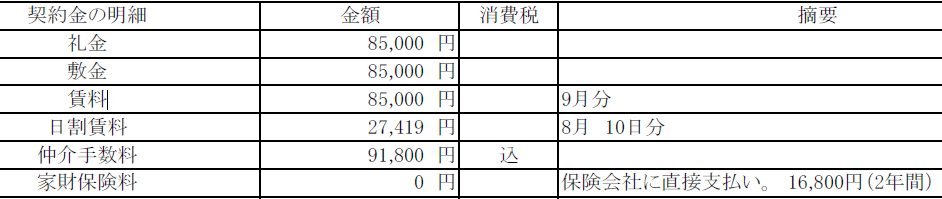
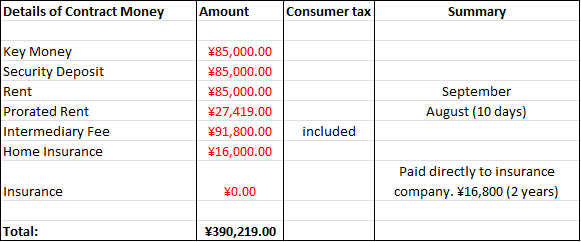
Here’s a real-life example of what it cost me on signing for my apartment (in Japanese, then translated). I began renting an apartment towards the end of August. It is a second-floor 2K in a wooden building (built in the 70’s) in Bunkyō-ku, very close to Tokyo University and two local train stations:
cost summary


cost summary (ENG)

As you can see, even without additional charges such as management fees, parking, lock-change fees, etc., my costs were still over $4,000, if you include the insurance I had to pay within the month (which came to me directly by mail). I had to pay both the prorated rent for the end of the month and my next months’ rent upfront as well, given the time that I was signing.

The best way for you to plan for how much your initial costs will be is to look at apartment listings online and start making spreadsheets or your best and worst case scenarios. At minimum, you may have to pay (blank), and at maximum you may have to pay (blank). My worst-case scenario budget was around $6,000, which I was positive I didn’t want to spend, but I wanted to make sure I had enough money on hand just in case I had to.

Other words you might come across for initial fees may include:

初期費用
shoki hiyō
initial moving fees one-time moving costs (I usually don’t see these, but they do exist.)
町内会費
chōnaikaihi
neighborhood association fee this is a cost of usually around $10 for people living in residential neighborhoods—some places have it, some don’t
更新手数料kōshintesūryō lease renewal fee this is a fee you’re charged every time you renew your lease—typically one month’s rent
鍵交換代
kaikōkandai
lock changing fee not every apartment has this, but some do, and it can cost as much as $200 at times

Note that most leases in Japan are for 2 years. There may be penalties for cancelling after only 1 year, although you will be able to find some places willing to negotiate or that will accept only 1 year contracts. Be sure to inquire about this upfront.

===

Phew! That’s it for now. Hopefully I’ve covered a lot of the how-to aspects of getting started and a number of the important subjects you’ll have to keep in mind as you plan for your rental prospects. The next article will be a practical guide to how to read apartment listings, and will describe in more detail the language used to describe and characteristics of Japanese apartments. If there’s anything I forgot here or you have further questions, please shoot us an email or leave a comment below. If I don’t have the answer, I’ll try to find someone who does!

Next article: Living in Japan Part 4: How to Read Apartment Listings

===

Links for additional advice and information:

Posted in applications, culture, graduate school, housing, living abroad, main posts, useful links | Tagged , , , , , , , , , , | 7 Comments

Job Opening: Asia-Pacific Center, College of Security Studies

job opening - 5Institution:       Asia Pacific Center, College of Security Studies
Location:          Hawaii, United States
Position:           Non-Tenure Track Faculty

The Asia-Pacific Center for Security Studies, is a Department of Defense academic institution providing a forum where current and future military and civilian leaders from 45 Asia-Pacific nations gather to foster improved multinational and interagency security cooperation and coordination in the Asia-Pacific region through focused executive education, leader development, regional outreach engagement, professional exchanges at conferences, and policy-relevant research. The Asia-Pacific Center for Security Studies is located in Honolulu, Hawaii.

The Center invites applications for:

FACULTY MEMBER

The College of Security Studies is searching for a world class educator to teach, facilitate, and conduct research. Responsibilities include:

–  Teaching elective courses and lecturing on selected regional security topics within executive education courses;
–  Facilitating seminars and planning and conducting workshops locally and throughout the Asia-Pacific region;
–  Contributing to syllabus development;
–  Conducting and publishing individual and group research;
–  Performing various administrative and staff duties to support Asia-Pacific Center academic functions.

Particular expertise is sought in the following areas:

  • Regional expertise in North East Asia.  In-depth knowledge of Korea or Japan is particularly sought.
  • Transnational threats, broadly framed, with a specific focus on terrorism, crime, human trafficking and drug trafficking in the Asia-Pacific region. Knowledge of national security policy, national counterterrorism strategy, regional security issues, and related subjects. Professional expertise at the operational or strategic/policy levels.
  • Organizational and leader development education with emphasis on communications, negotiations, conflict management, and the evolution of social and organizational networking.

Required minimum qualifications include:

  •      Masters Degree in Security Studies, Political Science, International Relations,  Economics, Anthropology, History, or a related discipline with extensive  practitioner experience in the region. A Ph.D. is highly desirable.
  •     Proven ability in teaching and seminar facilitation.

The following is “preferred” for ALL Faculty positions:

  • Expertise in security, defense, and/or political-economic issues in one or more countries in the Asia-Pacific region.
  • Living or working experience in the Asia-Pacific region.
  • Ability to converse in an Asian language.
  • Previous experience in a U.S. Department of Defense educational and/or research environment.

Salary and rank are commensurate with qualifications.  Salary range is $83,548-$135,000 (includes HI Locality pay but excludes cost of living allowance (COLA), currently 12.25% but subject to change).  These are limited-term, excepted-service positions, for up to three years (with the possibility of renewal).  Relocation expenses may be authorized.

APPLICATION PROCEDURES

  1. Interested candidates should submit the following items:
  2.  LETTER OF INTEREST.  Provide a brief description of your vocational goals, personal interests and expected areas of study in the coming year, and explain your interest in future career considerations with the Department of Defense.
  3.  CURRICULUM VITAE.  Should reflect the following: educational background, work experience, publications and salary history.
  4.  THREE ORIGINAL LETTERS OF REFERENCE.
  5. Submit all required documents to physical address:

Chief, Human Resources Department
Asia-Pacific Center for Security Studies
2058 Maluhia Road
Honolulu, Hawaii 96815-1949

or email to:

hrdapplications-apcss@hawaii.rr.com

ADDITIONAL INFORMATION

  1. Application deadline:  Open until filled.  First cut off: 5 December 2014; Second cut off: 1 March 2015.
  2. Applications will be considered against current Faculty requirements.  Application packages will be retained for one year.
  3. Application materials become the property of the U.S. Department of the Defense and will not be returned.
  4. Individuals selected for interviews will be asked to provide bona fide transcripts from the academic institutions granting their advanced degree(s) and two samples of their own publications.
  5. The Department of the Defense is an Equal Opportunity Employer.  All qualified candidates will receive consideration without regard to race, color, religion, sex, national origin, age, disability, marital status, political affiliation, sexual orientation, or any other non-merit factor.  U.S. Citizenship is not required however applicants must be eligible for an H1B or other work visa.
  6. The Department of the Defense provides reasonable accommodation to applicants with disabilities.  Applicants with disabilities who believe they require reasonable accommodation should contact the Center’s Human Resources Department athrdapplications-apcss@hawaii.rr.com to ensure that the Department of the Defense can consider such a request.  The decision to grant an accommodation will be made on a case-by-case basis.
  7. Learn more about the Asia-Pacific Center for Security Studies by visiting: www.apcss.org.
Posted in announcements, job openings, jobs | Tagged , , , , , | Leave a comment

Job Opening: Japanese Religious Studies

job opening - 5Institution:       University at Albany
Location:          New York, United States
Position:          Assistant Professor, Tenure Track – Japanese Religious Studies

Assistant Professor, Tenure Track – Japanese Religious Studies

The Department of East Asian Studies at the University at Albany, State University of New York, seeks candidates for a tenure track assistant professor position in Japanese Religious Studies to begin Fall 2015.

The successful candidate is expected to 1) teach five lower and upper division courses on pre-modern and modern Japan per year; 2) pursue an active program of research; and 3) participate in service responsibilities, including undergraduate advising.

Ph.D. in hand from a university accredited by a U.S. Department of Education or an internationally recognized accrediting organization is required. Preference will be given to candidates who focus on Buddhism and who have a sub-specialization in either Chinese or Korean Religious Studies, and those with near-native fluency in both English and Japanese.

Apply online at: http://albany.interviewexchange.com/jobofferdetails.jsp?JOBID=50506

Applicants must address in their applications their ability to work with and instruct a culturally diverse population.
The University at Albany is an EO/AA/IRCA/ADA Employer

Apply Here

Posted in announcements, job openings, jobs | Tagged , , , , , , , | Leave a comment

Funding: The Nippon Foundation Fellows Program at The Inter-University Center for Japanese Language Studies (IUC)

money [150-2]The Nippon Foundation Fellows Program at the Inter-University Center for Japanese Language Studies (IUC)

Scholarship Opportunity —advanced Japanese language training for graduate students with Japan-focused career goals in academia, business, diplomacy/government service, journalism, and law

The IUC is pleased to announce generous sponsorship from The Nippon Foundation of a 10-month fellowship program at the IUC. The Nippon Foundation Fellows Program at the IUC aims to provide the most promising students with the deep linguistic and cultural knowledge needed to become leaders in their fields, and to foster strong collegial bonds and intellectual exchange among themselves and with their IUC senpai.

Eligibility: PhD students in all fields of Japanese studies, currently enrolled in universities from North America, Europe, Australia, or New Zealand; MA, MS, MBA & JD students with Japan-focused career goals in business, diplomacy/government service, journalism and law currently enrolled or recently graduated from a North American university. Applicants must pass the IUC language exam.

Tuition: Fellows will receive a full tuition scholarship plus a modest living stipend to attend the 10-Month immersion program in advanced Japanese at the IUC in Yokohama.

The Nippon Foundation Fellows will:

  • Meet with each other and the IUC Resident Director on a monthly basis to discuss their research interests and experiences in Japan,
  • Invite two IUC alumni to offer public lectures in Japanese in Tokyo, and
  • Deliver a presentation in Japanese at one of three Nippon Foundation Fellows conferences open to the public.

Applications: http://web.stanford.edu/dept/IUC

Deadlines: PhD applicants: December 12, 2014

MA/MS/MBA/JD applicants: January 15, 2015

Inter-University Center
Encina Hall, Room C334
616 Serra Street
Stanford University
Stanford, CA 94305
Email: iucjapan@stanford.edu
Visit the website at http://web.stanford.edu/dept/IUC

Posted in announcements, financial assistance, funding, graduate school, living abroad | Tagged , , , , , , , | Leave a comment

Job Opening: Asian urbanism, Hamilton College

job opening - 5Institution:       Hamilton College
Location:          New York, United States
Position:           Post-Doctoral Fellow, Asian Studies

The Asian Studies Program at Hamilton College invites applications for a two-year postdoctoral position in any discipline for a scholar working on Asian Urbanism to begin July 1, 2015. Applicants must have completed Ph.D. by the time of appointment and possess a demonstrated commitment to excellence in research and teaching. Mastery of a relevant Asian language is expected. The successful candidate will be housed in the department appropriate to their training, teaching three courses a year. The annual salary is $50,000 for the candidate with Ph.D. in hand.

Hamilton (www.hamilton.edu) is a residential liberal arts college located in upstate New York. Applicants with dual-career considerations can find other Hamilton and nearby academic job listings at www.upstatenyherc.org. Hamilton College is an Affirmative Action, Equal Opportunity Employer and is committed to diversity in all areas of the campus community.

Submit application materials, including a letter of application, c.v., dissertation abstract (Dissertation Abstracts Online version), a writing sample, three letters of recommendation, and two course syllabi to Interfolio at apply.interfolio.com/27056. Review of applications will begin December 15, 2014.

Contact:

Address inquiries to Professor Lisa Trivedi, Asian Urbanism Post-Doctoral Search, Search Committee Chair, Hamilton College, 198 College Hill Road, Clinton, NY, 13323.

Website:           apply.interfolio.com/27056

Posted in announcements, job openings, jobs | Tagged , , , , , , | Leave a comment

Job Opening: Executive and Program Assistant, Sasakawa Peace Foundation USA

job opening - 5Institution: Sasakawa Peace Foundation USA
Location: Washington, DC
Application deadline: November 17, 2014
Education requirements: 4-year degree , Japanese Studies , History , Asian Studies , Policy Studies , Public Policy , Political Science , East Asian Studies
Level of language proficiency: English – native-level fluency; Japanese – some proficiency preferred (oral & written)

Sasakawa Peace Foundation USA is a 501c3 non-profit located in Washington, DC involved in U.S.-Japan relations, providing conferences and seminars, think tank analysis, people-to-people exchanges and coordination of high-level dialogue between the two countries through our in-house and collaborative programs. Sasakawa USA is independent from but works closely with our sister foundation in Tokyo, Sasakawa Peace Foundation.

Sasakawa USA seeks an enthusiastic entry-level Executive and Program Assistant to provide administrative support to the Chairman and CEO and other staff. While about half of the Assistant’s time will be spent on executive scheduling, he/she will also aid the quickly growing programs team in all programmatic functions, including proposal development, event planning, execution and follow-up, and internal and external coordination and communications. The Executive and Program Assistant will also be in charge of office reception, and will work closely with the Administrative office for general office maintenance and streamlining of administrative and accounting-related tasks involving the Program staff.

Requirements:

  • Bachelor’s degree in relevant field (Japanese Studies, International Relations, History, Political Science, or area studies relevant to Japan and Asia)
  • Strong written and oral communications skills (English language)
  • Knowledge of and demonstrated interest in U.S-Japan relations
  • Attention to detail and ability to multi-task
  • Strong organizational skills
  • Proactive efforts to identify and address new administrative issues
  • Flexibility and excellent interpersonal skills
  • Project coordination experience
  • Demonstrated ability to work in a team
  • Strong computer and Internet research skills
  • Proficiency in Microsoft Office
  • Authorization to work in the US (non-US citizens must possess work authorization that does not require employer sponsorship for a visa)

Preferred Skills:

  • Proficiency in written and oral Japanese
  • Administrative support experience
  • Experience in non-profit programs and event planning

Responsibilities:

  • Manage schedules, including meeting and event arrangements as needed for the Chairman and CEO and making travel arrangements as needed
  • Sit at reception desk; screen calls, greet office guests and coordinate arrangements such as early or after hour guest entry
  • Provide administrative and programmatic support to the Programs team for its research and education programs
  • Assist in developing project proposals, formulating budgets and tracking expenditure of funds
  • Research information as requested by staff on potential project partners, current developments in U.S.-Japan relations and Sasakawa USA research areas
  • Help organize conferences, roundtables and other events on U.S-Japan relations in and outside of Washington, D.C.
  • Help organize visits to Japan by American scholars and practitioners or visits to the United States by Japanese scholars and practitioners.
  • Assist administrative office in office upkeep such as ordering supplies and scheduling maintenance on equipment
  • Assist administrative office to make and keep track of staff reimbursements and project-related payments

Full details on Idealist.org

Posted in announcements, job openings, jobs | Tagged , , , , | Leave a comment

Book Announcement: The Sarashina Diary: A Woman’s Life in Eleventh-century Japan

The Sarashina DiarySonja Arntzen and Itō Moriyuki are pleased to announce the publication of their collaborative work, which as some subscribers to this list know has been a long time in preparation:

The Sarashina Diary: A Woman’s Life in Eleventh-century Japan, by Sugawara no Takasue no Musume,
translated and with an introduction by Sonja Arntzen and Itō Moriyuki. Columbia University Press, 2014. Cloth, 264 pages, 17 illus., 3 maps.

A thousand years ago, a young Japanese girl embarked on a journey from the wild East Country to the capital. She began a diary that she would continue to write for the next forty years and compile later in life, bringing lasting prestige to her family.

Some aspects of the author’s life and text seem curiously modern. She married at age thirty-three and identified herself as a reader and writer more than as a wife and mother. Enthralled by romantic fiction, she wrote extensively about the disillusioning blows that reality can deal to fantasy. The Sarashina Diaryis a portrait of the writer as reader and an exploration of the power of reading to shape one’s expectations and aspirations.

As a person and an author, this writer presages the medieval era in Japan with her deep concern for Buddhist belief and practice. Her narrative’s main thread follows a trajectory from youthful infatuation with romantic fantasy to the disillusionment of age and concern for the afterlife; yet, at the same time, many passages erase the dichotomy between literary illusion and spiritual truth. This new translation captures the lyrical richness of the original text while revealing its subtle structure and ironic meaning. The introduction highlights the poetry in the Sarashina Diary and the juxtaposition of poetic passages and narrative prose, which brings meta-meanings into play. The translators’ commentary offers insight into the author’s family and world, as well as the fascinating textual legacy of her work.

“This sparkling new version of the Sarashina Diary opens out an eleventh-century classic for twenty-first-century readers. Sonja Arntzen and Itō Moriyuki situate the diary culturally and historically, and their translation conveys the vivid realism of Takasue no Musume’s prose and the haunting melancholy of her poems.  As the author herself says of Mt. Fuji, this unique work “looks like nothing else in the world.”

David Damrosch, Harvard University

Good news:  Columbia University Press is offering a discount:

The webpage for the book is

http://www.cup.columbia.edu/book/978-0-231-16718-5/the-sarashina-diary

Posted in announcements, culture | Tagged , , , , , , , | 2 Comments

Job Opening: Japanese Studies, Full Professor, University of Macau

job opening - 5Institution:       University of Macau, The Centre for Japanese Studies of the Faculty of Arts and Humanities
Location:          Macau
Position:          Full Professor of Japanese Studies

The University of Macau is the leading higher education institution in Macao, with English as its working language. In recent years, the University has been making great progress towards becoming internationally recognized for its excellence in teaching, research and service. With the beautiful new campus (20 times larger than the old one) becoming fully operational recently, the launch of Asia’s largest residential college system, the establishment of new schools, and the increasing numbers of students and faculty members recruited from around the world, UM provides great potential and exciting new possibilities for growth and development.

The Centre for Japanese Studies of the Faculty of Arts and Humanities invites applications for the position of Professor of Japanese Studies.

The Centre for Japanese Studies is an established and lively scholarly community with a strong international tradition for the teaching of Japanese language. In addition to its undergraduate BA programme in Japanese Studies, the Centre offers an undergraduate Minor in Japanese Studies, as well as possible PhD supervision across the range of the department’s expertise. The Centre has particular strengths in Japanese linguistics and anthropological approaches to Asian studies. In addition to undergraduate language teaching graduate-level teaching and supervision may be expected within Japanese Studies or related areas.

Qualifications

Applicants must hold a PhD in Japanese Studies or in a related area. Applicants should have an excellent record of tertiary teaching and supervision experience and a distinguished record of research and publication at an international level. Academic specialization is open. Applicants should have native or near-native fluency in Japanese along with extensive experience teaching Japanese as a second/foreign language. A good command of English is also preferred. Applicants with administrative experience are especially welcome.

The selected candidate is expected to assume duty in August 2015.

Position and Remuneration

Remuneration and appointment rank offered will be competitive and commensurate with the successful applicants’ academic qualification, current position and professional experience. The current local maximum income tax rate is 12% but is effectively around 5% – 7% after various discretionary exemptions.

Application Procedure

Applicants should visit http://www.umac.mo/vacancy for more details, and apply ONLINE at Jobs@UM(https://isw.umac.mo/recruitment) (Ref. No.: FAH/PJS/08/2015). Review of applications will commence on 1st December 2014 and continue until the position is filled. Applicants may consider their applications not successful if they were not invited for an interview within 3 months of application.

The effective position and salary index are subject to the Personnel Statute of the University of Macau in force. The University of Macau reserves the right not to appoint a candidate. Applicants with less qualification and experience can be offered lower positions under special circumstances.
***Personal data provided by applicants will be kept confidential and used for recruitment purpose only***


Posted in announcements, job openings, jobs | Tagged , , , , , | Leave a comment

Call for Papers: Re:locations, Journal of the Asia-Pacific World

call for papers [150-2]Based out of the Asian Institute at the University of Toronto, Re:locationsJournal of the Asia-Pacific World  is a new peer-reviewed, student-run journal that seeks to foster dialogue among student researchers working across disciplines, institutions, and regions in Asia and the Pacific.

Call for Submissions

Re:locations is inviting submissions for a special issue to be published online in Spring 2015, “Leveled: The Meaning and Making of Disaster in Asia”. Over the past decade, Asia has featured in global headlines as the locus of disasters that are unprecedented in complexity and scope.  From the 2004 Indian Ocean tsunami to the 2011 earthquake that precipitated the Fukushima nuclear disaster, these tragedies hint at new forms of calamity that extend far beyond national borders and challenge distinctions between “natural” and “manmade” disasters. Re:locations is seeking papers, reviews, poetry, and artwork that examine the impact that disasters have had on the region from cultural, environmental, economic, political, and historical perspectives. Themes may include, but are not limited to:

  • Exploring the limits of current “disaster management” paradigms, and evaluating historical shifts in how disasters are perceived and managed
  • Analyzing the different impact of disaster on marginalized groups
  • Exploring the role of religious and civil society groups in post-disaster scenarios
  • Investigating the politics of international aid in Asia
  • Examining how disaster is framed in art and media
  • Investigating the impact that recent disasters have had on climate change policy and public perceptions of risk and climate change in the region

Journal submissions should be emailed to the Senior Editor at relocationsjournal@gmail.comin .doc format by December 15, 2014.

Jennifer McCann; Jessica Wilczak; Jacob Hogan
Email: relocationsjournal@gmail.com

Posted in announcements, graduate school | Tagged , , , , | Leave a comment