
Workshop: 12th EAJS Workshop for Doctoral Students

call for papers [150-2]Call for Applications: 12th EAJS Workshop for Doctoral Students

Venue: EHESS (École des Hautes Études en Sciences Sociales/School of Advanced Studies in Social Sciences), Paris, France

Date: 4-7 July 2016

Project director: Dr Sébastien Lechevalier (EHESS)

Language for applications and during the workshop: English

Application deadline: 31 March 2016

To apply please use our online application system.

The European Association for Japanese Studies (EAJS) invites doctoral students in all humanities and social sciences to apply for the 12th EAJS Workshop for Doctoral Students (4 -7 July 2016). The workshop will take place at EHESS (École des Hautes Études en Sciences Sociales/School of Advanced Studies in Social Sciences) in Paris, France. EAJS will cover the costs of travel (up to 400 EUR) and accommodation for the duration of the workshop for a group of 18-20 doctoral students and 4-5 senior scholars who will act as advisors.

The EAJS Workshops for Doctoral Students aim to create a European multidisciplinary network of advanced graduate students and senior scholars in Japanese Studies. The informal environment of the workshop provides a unique opportunity for participants to work together intensively to enhance individual projects and engage in in-depth discussions of common themes and methods. Through presentations and focused sessions, students give and receive critical feedback on dissertation projects, fieldwork plans and preliminary results. Students will be asked to read the work of their peers and prepare for workshop presentations linking their own work to the broader international Japanese Studies field. Students will also get one-to-one supervision with a senior scholar in their respective field.

Eligibility

Graduate students working on a dissertation topic related to Japan, regardless of citizenship, who are enrolled at universities in Europe, and students of European nationality who are enrolled in graduate programmes outside Europe are eligible. Students travelling to the workshop from outside Europe should expect no more than 400 EUR to be paid towards their transportation costs. Doctoral Students from European universities that do not have major centres of Japanese Studies are especially encouraged to apply. Applications are particularly welcome from graduate students in the early fieldwork phase through the middle stages of dissertation writing. All applicants are expected to have studied the Japanese language and to use materials written in Japanese as sources for their dissertations. Applicants are expected to provide evidence of Japanese language ability in their applications.

Application and Selection Process

Please be aware that EAJS uses an online system to manage submissions for its workshop for doctoral students.

In the first instance your application should include:

  • A curriculum vitae
  • A short cover letter (maximum 250 words), indicating why you wish to attend the workshop as well as the current state of progress of the doctoral work
  • A summary of the dissertation project (maximum 500 words), explaining topic, relevance, research question, methodology, and current stage of the dissertation project

These documents must be submitted via the application website by 31 March 2016. Selected candidates will be notified by 30 April 2016.

Short-listed candidates will then be required to send a project report (about 5000 words) to the project director by 31 May 2016.

This project report should have the following structure:

  1. title and author
  2. abstract with keywords
  3. current state of research (empirical findings and theories) and research gap(s)
  4. research question of project and its relevance respectively own motivation
  5. theoretical framework, methodology of project, and schedule
  6. hypotheses and/or preliminary results
  7. (possible) difficulties in realizing research project
  8. quoted literature

It goes without saying that the project report should conform to best academic practice (language, referencing, etc.). It will be the basis for short presentations on the individual research projects, for group presentations and discussions, and for the individual supervision.

Note that the second application stage will not be competitive. Each applicant who receives a request to send in a full project report will be accepted. However, an extension of the deadline for the project report will not be possible since all project reports need to be sent to all participants. Shortlisted candidates who fail to submit their project report by the deadline will not be admitted to the workshop.

All selected candidates will furthermore be required to submit a short report (250-300 words) on their participation in the workshop until 31 August 2016.

Reports by participating scholars will appear on the EAJS website at www.eajs.eu as well as in the EAJS Bulletin.

Accepted candidates will also be required to join the European Association for Japanese Studies.

For all enquiries please feel free to contact us via email at office[at]eajs.eu.

Contact Info:

Tim Herbort
Office of the European Association for Japanese Studies (EAJS)
c/o Freie Universität Berlin
Institute of East Asian Studies
Japanese Studies
Hittorfstr. 18
14195 Berlin
Germany
Phone: +49 30 838 50929
Fax: +49 30 838 450931
Contact Email:
office@eajs.eu
URL:
http://www.eajs.eu/index.php?id=754

Posted in announcements, conferences, graduate school | Tagged , , , , , , , | Leave a comment

Workshop: Traditional Theater Training, Kyoto (summer 2016)

Want to train with real masters in Kyoto this summer?

The 32nd annual Traditional Theater Training (T.T.T.) 2016 will be held at the Kyoto Art Center.

T.T.T. is a three-week summer intensive training program that introduces the traditional arts of noh, kyogen, and Nihonbuyo. The program is based on the practice-recital approach, and aims to allow participants from all over the world to learn the skills and spirit of traditional performing arts.

This year’s program is scheduled to begin in late July and end in early August (approx. three weeks). The instructors will be Shingo Katayama, Hiromichi Tamoi, and Nobuyuki Oe (Noh); Akira Shigeyama, Yasushi Maruishi, and Doji Shigeyama (Kyogen); and Yayoi Wakayagi and pupils (Nihonbuyo). Fluency in Japanese is not required of participants, though lessons will typically be given in the language (with interpreters on hand).

Application will be open from February 2016 and discounts are given to early applications, students, and artists. For more information feel free to respond to me directly, or contact Kyoto Art Center (in Japanese or English) at t.t.t@kac.or.jp or+81(0)75-213-1000. You can visit the KAC website at http://www.kac.or.jp. 


Posted in announcements, culture, graduate school, study tools, summer program | Tagged , , , , , , , , , | Leave a comment

Funding: MA and PhD funding at Newcastle University (UK)

money [150-2]We are pleased to announce the following funding opportunity for MA or PhD in Japanese studies at Newcastle University (UK):
Sasakawa Studentships in Japanese Studies

Closing Date: 15 March 2016

The studentships form part of a five year programme designed to support the study of Japan in the UK at postgraduate level which the Nippon Foundation and the Great Britain Sasakawa Foundation launched in 2014. Up to three studentships (MA or PhD) will be available per annum, each worth £10,000. We invite applications from suitably qualified candidates who wish to pursue an MLitt (Masters by Research) or a PhD in Japanese studies, starting October 2016. We particularly encourage students with an interest in contemporary Japanese literature, gender and/or popular culture to apply, but still welcome applications from candidates with an interest in any area of Japanese studies.

Candidates of any nationality are eligible to apply for the studentships. Non-UK nationals applying for Masters studentships are eligible only if they are settled in the UK or have been ordinarily resident for at least three years immediately preceding the start of their Masters course. This does not apply to PhD studentship candidates.

How to apply

To be considered for nomination, you must:

  1. Register your interest and discuss your research proposal with Dr Gitte Hansen (hansen@newcastle.ac.uk)
  1. Apply online for a place on either our PhD or MLitt programmes via thecentral portal for Postgraduate Admissions. You must hold a conditional or unconditional offer of a place before you can be nominated. The deadline for applying on the central portal is 5pm on 15 March 2016.

For more detailed information about the award scheme, please refer to the Great Britain Sasakawa Foundation website: http://www.gbsf.org.uk/general/index.html

Japanese studies at Newcastle University is located within the School of Modern Languages (http://www.ncl.ac.uk/sml/), where research focuses on contemporary Japanese gender, popular culture, contemporary Japanese literature, and film. The Japan section works closely with Japan-focused researchers at the School of History and the School of Geography, Politics and Sociology and, through the recently established Asian Studies Research Group (ASRG), the university offers post graduate students a highly multidisciplinary environment for the study of Japan and Asia. To further promote the humanities both within and beyond the University, the Humanities Research Institute (http://www.ncl.ac.uk/nuhri/) was founded in 2015 to catalyse, coordinate and support research in the humanities at the university.

You can find out more about Newcastle University at:  http://www.ncl.ac.uk/

For any enquiry on Japanese Studies at Newcastle, contact Dr Gitte Hansen (gitte.hansen@newcastle.ac.uk)

Posted in announcements, funding, graduate school | Tagged , , , , , | Leave a comment

Call for Papers: Children, Family and Migration in East Asia

call for papers [150-2]This international conference is jointly organized by the Asia Research Institute, National University of Singapore, and the Department of Sociology, The Chinese University of Hong Kong.

Under conditions of economic globalization, migration across borders – whether international or internal – has become part of childhood experiences of many children in East Asia. While children are heavily involved in a wide range of migration streams in the region, they (with a few exceptions) continue to remain in the background of migration scholarship that is dominated by a focus on adult-centric labour migration concerns and processes. In this context, this conference sets out to examine the complex and multi-faceted ways in which East Asian children’s lives – as they unfold in familial contexts – are intersected by migration processes and pressures. Children in migratory contexts are complex social actors who eschew easy classification into the binary states of ‘agent’ or ‘victim’. They embody agency and resilience in situated practices, shape and are shaped by normative structures of familial and intergenerational relationships, and are deeply implicated in the negotiation of subjectivities folded into processes of development and change throughout the region.

In East Asia, the well-being of children (defined here broadly as those aged below 18) is often closely associated with family contexts and migration in at least four ways. First, in the developing economies in the region, when parents migrate to more affluent destinations in search of better work opportunities, children may be left behind and taken care of by other family members or substitute carers. For left-behind children, parents’ migration may have multiple and sometimes contradictory effects, improving their well-being through remittances sent home, or affecting their lives adversely as a result of the absence of primary carers. Second, children may move and migrate with their family members. The well-being of migrant children in post-migration situations is often uncertain because they may lack access to needed education, health and other services due to their migration status.  Third, some migrant workers bear children during their migration stints. This often creates a challenge for both parents and children, because migrant workers may face discrimination and marginalization in the host society. Children born of female migrant workers often do not have citizenship or residency rights in their birth place given their mothers’ transient – often precarious – labour migrant status. Children born ‘out of place’ in host societies may also encounter stigmatization in returning to their parents’ origin communities. Fourth, in more affluent societies in the region, middle class parents have increasingly used migration as a strategy to improve their children’s future prospects. For example, in order to help their children obtain citizenship rights in more developed societies, pregnant women may migrate to give birth. In other instances, mothers from middle class families may migrate to accompany their children who pursue educational pathways overseas.

The above four strands linking children, family and migration illustrate the critical impact that family circumstances and migration contexts have on children’s lives, regardless of whether the children move or stay. We are particularly interested in the way these strands develop in the context of intra-regional migrations in East Asia, primarily because the East Asian arena has been given less attention compared to the larger vein of work exploring issues related to children of Asian migrants in the global North. This conference takes children, family and migration in East Asia as its focus, and addresses the following key issues:

  • How do children shape family migration decisions?
  • How does migration impact the well-being, identity and subjectivity of children who move and children who stay?
  • How do structural factors such as gender and class intersect with migration to shape children’s lives?
  • What strategies are mobilized to cope with the challenges stemming from migration that affect children’s well-being?
  • How do these strategies converge and diverge across different cultural and social contexts and among different groups of children bearing different gender, class and citizenship status?

We hope to bring together theoretically informed, empirically grounded papers which reflect the wide range of issues and experiences relating to children, family and migration in the context of East Asia. The conference is open to analyses using qualitative and/or quantitative methods. Papers focusing on Japan, South Korea, Vietnam, Malaysia, Burma, and Cambodia are particularly welcome.

KEYNOTE SPEAKER

Prof Pierrette Hondagneu-Sotelo | Professor of Sociology, University of Southern California, USA

ABSTRACTS SUBMISSION

Paper proposals should include a title, an abstract (300 words maximum) and a brief personal biography of 150 words. Please send all proposals in MS word document format to Ms Valerie Yeo at valerie.yeo@nus.edu.sg, no later than 1 March 2016. Late submissions will not be considered.

The abstract should address one or more of the key issues listed above in an East Asian context. It should also clarify the substantive issues which the full paper will address and include information on objectives, methods, and findings. Please also explain the original contribution the research makes to the field of study. As selected papers (after the appropriate revision) will be included in a collective publication (such as a journal special issue), papers should be based on unpublished material and should not be already committed elsewhere.

Successful applicants will be notified by end March 2016. Those selected will have to submit full-length papers, of around 6,000 words in length, by 10 June 2016.

Limited funding is available for a small number of presenters and will be awarded on a by-case basis.

CONVENORS

Professor Brenda S.A. Yeoh 
Asia Research Institute & Department of Geography, NUS
E | geoysa@nus.edu.sg

Professor Susanne Choi
Department of Sociology, The Chinese University of Hong Kong
E | choiyp@cuhk.edu.hk

Ms Theodora Lam
Asia Research Institute, NUS
E | theodoralam@nus.edu.sg

Contact Info:

Ms Valerie Yeo
Asia Research Institute
National University of Singapore
E | valerie.yeo@nus.edu.sg

Contact Email:

valerie.yeo@nus.edu.sg

URL:

http://www.ari.nus.edu.sg/upload/events-pdf/20160707_ChildrenFamilyAndMigration_CW.pdf


Posted in Uncategorized | Tagged , , , , , | Leave a comment

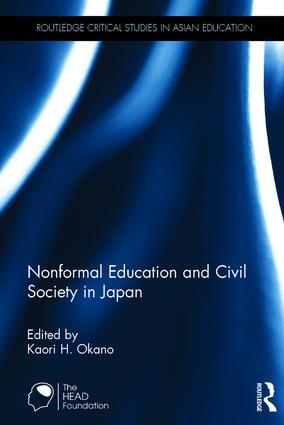
Book Announcement: Nonformal Education and Civil Society in Japan

educationNonformal Education and Civil Society in Japan

edited by Kaori H. Okano
Critical Studies in Asian Education series
About the Book

Nonformal Education and Civil Society in Japan critically examines an aspect of education that has received little attention to date: intentional teaching and learning activities that occur outside formal schooling.

In the last two decades nonformal education has rapidly increased in extent and significance. This is because individual needs for education have become so diverse and rapidly changing that formal education alone is unable to satisfy them. Increasingly diverse demands on education resulted from a combination of transnational migration, heightened human rights awareness, the aging population, and competition in the globalised labour market. Some in the private sector saw this situation as a business opportunity. Others in the civil society volunteered to assist the vulnerable. The rise in nonformal education has also been facilitated by national policy developments since the 1990s.

Drawing on case studies, this book illuminates a diverse range of nonformal education activities; and suggests that the nature of the relationship between nonformal education and mainstream schooling has changed. Not only have the two sectors become more interdependent, but the formal education sector increasingly acknowledges nonformal education’s important and necessary roles. These changes signal a significant departure from the past in the overall functioning of Japanese education. The case studies include: neighbourhood homework clubs for migrant children, community-based literacy classes, after-school care programs, sport clubs, alternative schools for long-term absent students, schools for foreigners, training in intercultural competence at universities and corporations, kōminkan (community halls), and lifelong learning for the seniors. This book will appeal to both scholars of Japanese Studies/Asian Studies, and those of comparative education and sociology/anthropology of education.

Table of Contents

  1. Nonformal education in Japan: Its interface with formal schools, Kaori Okano 2. The homework club and beyond: A civil society group’s quest to build a place for learning and belonging in a time of migration,Tomoko Nakamatsu 3. The importance of nonformal education in the success of Dôwa Education, June A. Gordon 4. Community based after-school care programs in Japan: Potential of non-formal education for children and residents, Eiji Tsuda 5. Homo Athleticus: The Educational Roles of Extracurricular Clubs in Japanese Schools, Thomas Blackwood 6. Alternative Schools: An Educational Safety-net for Long-term Absent Students, Hideki Ito 7. The changing relationship between ‘schools for foreigners’ and formal schools, Kaori Okano 8. Education and training for the intercultural competence of Japanese university graduates: Policy, practice and markets in informal education, Jeremy Breaden 9. Kōminkan: Its Roles in Education and Community-Building, Chizu Sato 10. Lifelong learning universities in the ageing society: Empowering the elderly, Koji Maeda

Reviews

This volume provides an integrated view of how learning in Japan occurs outside of schools, from kindergarten to universities for the elderly. It explores how migrants and indigenous minorities cope with public schooling through non-formal means, and offers a rare look at the role that religious organizations sometimes play in Japanese society. — Professor Gerald Le Tendre, Pennsylvania State University

Non-formal education is often a neglected area of scholarly investigation. Yet, it occupies significant space and importance in everyday life in our contemporary society, providing all generations with alternative learning opportunities. This book will be a unique contribution that highlights the interface between formal and non-formal education and provides readers with multilayered understanding of learning in post-industrial Japan. — Professor Ryuko Kubota, University of British Columbia

For more information, please see the publisher’s website:  https://www.routledge.com/products/9780415745307

Posted in announcements, culture | Tagged , , , , , , , | Leave a comment

Conference: Multifaceted Divinities in Japan and Beyond

call for papers [150-2]Multifaceted Divinities in Japan and Beyond

The Hebrew University of Jerusalem and Tel-Aviv University

May 29-31, 2016

The Israeli Association of Japanese Studies (IAJS) is glad to announce an international workshop on Japanese medieval divinities, which will be held at the Hebrew University of Jerusalem and Tel-Aviv University on May 29-31, 2016. The workshop is dedicated to the memory of the Late Prof. R.J. Zwi Werblowsky (Hebrew University), a renowned scholar of comparative religion, who passed away last summer.

The workshop seeks to examine the confluence of various religious systems in medieval Japan through portraits of individual, often multifaceted or pantheon-like, divinities. While investigating the complex identity of these divinities, the presentations will look more broadly at the dialectics of Buddhism (and other imported traditions) and localism, which shaped and disseminated all aspects of Japanese religiosity.

Throughout the medieval period the pantheon was continuously shaped and re-shaped both by inner currents within the religious sphere and by social, geographical and political circumstances specific to Japan. This concurrence is manifested in the multiple and chaotic identities of individual divinities. Rather than mere objects of worship, these divinities functioned as powerful and efficacious figures that shaped reality through complex ritual systems. They were pivotal entities in the creation of notions of identity, territory and sovereignty, and their combinatory nature had impact on their social and political roles.

The examination of Buddhism and local cults in Japan calls for a broader exploration of the theme in other Asian cultures where divinities of local cults throve under Buddhist and other religious influences. The workshop will thus incorporate a panel dealing with divinities of complex nature in other Asian cultures, and will conclude with a round table discussion on the combinatory phenomenon in a comparative fashion. Our aim is to look beyond the dichotomy of Buddhism and localism with which we start and to open a theoretical discussion on the multivalent identity of Asian gods.

Keynote speaker: Bernard Faure, Columbia University

Participants: Abe Yasurō (Nagoya University); Irit Averbuch (Tel-Aviv University); Lucia Dolce (SOAS); Ehud Halperin (Tel-Aviv University); Kadoya Atsushi (Iwaki Meisei University); Sujung Kim (DePauw University); Yagi Morris (SOAS); Or Porath (UCSB); Fabio Rambelli (University of California, Santa Barbara); Gil Raz (Dartmouth College); Jacob Raz (Tel-Aviv University); Carina Roth Al Eid (University of Geneva); Saitō Hideki (Buddhist University); Gaynor Sekimori (SOAS, London); Meir Shahar (Tel-Aviv University); Eviatar Shulman (Hebrew University); Suzuki Masataka (Keio University); Mark Teeuwen (Oslo University).

We welcome scholars and students who wish to attend the workshop. Those who are interested in further details please contact the organizers Irit Averbuch (airit@post.tau.ac.il) and Yagi Morris (yagimorris@gmail.com). The conference site will be accessible via the IAJS website (http://www.japan-studies.org).

The Organizing Committee:
Dr. Irit Averbuch (Tel Aviv University)
Ms. Yagi Morris (SOAS)

IAJS Academic Committee
Dr. Shalmit Bejarano (Hebrew University of Jerusalem)
Prof. Rotem Kowner (University of Haifa)

Posted in announcements, conferences, graduate school | Tagged , , , , , | Leave a comment

Job Opening: one-year position in Buddhist and Asian Religious Traditions at Vanderbilt

job opening - 5Institution: Vanderbilt University, Dept. of Religious Studies
Location: Nashville, Tennessee
Position: One-year (Non-Tenure-Track) Assistant Professor

The Department of Religious Studies at Vanderbilt University seeks to hire a sabbatical replacement for Buddhist Traditions and Asian Religions. The rank is Non-Tenure-Track Assistant Professor for a terminal one year appointment, for academic year 2016-17. All requirements for the Ph.D. must be met before the start of the appointment in August 2016.

The standard course load is two courses per term. The successful candidate must teach a one course survey of Buddhist Traditions and other introductory and advanced courses in Asian Religions commensurate to training in either East Asian, Tibetan and Himalayan, or South Asian regions. The area of specialization, historical period, and methodological approach are open. Command of languages appropriate to an advanced research agenda will be required.

Review of applications will begin on Thursday 25 February 2016 and will remain open
until the position is successfully filled.

To apply: Please upload the following materials to RLSTjobs@vanderbilt.edu:
*A letter of application that includes a statement of teaching philosophy and research interests
*Teaching evaluations (if available)
*Transcripts
*Three confidential letters of recommendation (or standard university graduate student placement dossier)

Posted in announcements, job openings, jobs | Tagged , , , | Leave a comment

Fun Link Friday: A history of Japan

If you have two eyes, know someone who knows something about Japan, and are on the internet, you have probably already been linked to this viral video that’s made the rounds in the last couple days. A 9-minute summary of Japanese history from the beginning of time to the modern day, this hilarious video got us pretty bad. Sure, there are some historical inaccuracies to nit-pick, but I definitely bust a gut the whole way through. 😉 Happy Friday!

Posted in culture, fun links | Tagged , , , , | Leave a comment

Call for Papers: The Reconstruction of East Asia, 1945-65

call for papers [150-2]European Research Council Project The Dissolution of the Japanese Empire and the Struggle for Legitimacy in Postwar East Asia, 1945-1965″, and Dr. Barak Kushner, Principal Investigator, are pleased to announce the conference:

The Reconstruction of East Asia, 1945-65 

Cambridge University, UK, December 9-12, 2016

Aim of the conference: this gathering will question how the collapse of the Japanese empire affected the region and how a host of different and competing groups struggled to remap and revision East Asia in the aftermath of the end of empire. The effort will examine these events from an East Asian and transnational perspective.

Our goal is to generate new dialogues among scholars who work on a wide variety of historical and geographical perspectives, focusing on China, Japan, Korea (South and North), and Taiwan. Scholars researching aspects of military demobilization, law and responsibility, the reorganization of authority and new political ideologies, transformations in postwar society, culture, the manufacture of identity, the geo-political restructuring of borders, and ethnic or nationalist violence in reconstructed East Asia in the two decades following the end of World War Two are encouraged to apply.

Topics may include but are not limited to:

  • War crimes trials but moving beyond what is already starting to emerge in the field
  • Traitor trials and/or issues of collaboration
  • Peace treaty negotiations that shed new light on the era
  • Gender issues
  • Problems of migration arising in the immediate postwar
  • Purges in East Asia
  • Important incidents: such as the 2.28 incident, the Shibuya Incident, the Cheju Island Incident
  • The reapplication of law or creation of new courts in many countries and how they interacted
  • Memorial legacies and related subjects
  • Problems in demobilization, demilitarization

See the larger goals of the ERC project and a full write up of previous conferences and outputs at the ERC Project website: http://www.warcrimesandempire.com. Questions about the project can be addressed to Dr. Barak Kushnerbk284@cam.ac.uk

**Deadline to send in a 500-word summary and 3-page CV for application: March 1, 2016.  Please email submissions to the conference address: reconstructionofeastasia@gmail.com

Suitable participants will be contacted and will be kindly asked to send a full version of their paper by November 20, 2016 (5,000 words). The papers will be pre-circulated in order to facilitate discussion during the conference.

Travel costs (economy) and the costs of accommodation in Cambridge (3 nights) will be covered for all workshop participants. Workshop participants may be invited to submit their papers for publication.

We would be grateful for sharing this call for papers among interested scholars and colleagues.

Best,

Barak Kushner, PhD,
Reader in Japanese History (Associate Professor)
Department of East Asian Studies/Faculty of Asian and Middle Eastern Studies
University of Cambridge
Sidgwick Avenue
Cambridge CB3 9DA
United Kingdom

Fellow of Corpus Christi College
phone: 44 (0)1223-335-174
fax: 44 (0)1223-335-110
bk284@cam.ac.uk

Posted in announcements, conferences, graduate school | Tagged , , , , , , | Leave a comment

Resource: くすりのしおり (Drug Information Sheet)

Winter is the time for colds and flus, and nobody is immune. Many foreigners dread getting sick overseas, especially when they aren’t sure how the Japanese health system works or just what kind of medicine they’re being prescribed. During my nasty bout of sinus-related woes this winter, I stumbled across くすりのしおり(Drug Information Sheet), an online bilingual guide to Japanese medications.

kusuri

While doctors in Japan will almost always give you printouts with information on the medications you’re receiving, they are seldom in English, which is where this site really comes in handy. You can look up your medication in Japanese or English, by company, or through other more specific means such as the active substance, dosage form, print on wrapping, or other keywords. There is also an option to look through names of medications alphabetically, which is great if you’re not that well-versed in Japanese and someone has told you the name but you don’t quite remember it.

kusuri2Another wonderful feature of this site is that with each entry for the medications is a picture of what it looks like, so again, those with limited Japanese or those who aren’t quite sure what they’ve found is the same thing as what’s in their hand can compare it visually. If you’re searching for medications specific to a certain function or area of the body, the left-hand “advanced search” option allows you to search (in English) by area of the body or type of medicine (internal, external, etc.).

For each medication there is a brief explanation in English of what it is typically used for, and if you click for the Japanese version there is a full explanation with extensive details provided in Japanese. There are also direct links to the pharmaceutical company that produces each medication in case you want to investigate even further.

This is a really handy quick reference for those not familiar with Japanese medications, so be sure to bookmark it, just in case the occasion arises!

Posted in living abroad, study abroad, useful links | Tagged , , , , , , | Leave a comment