
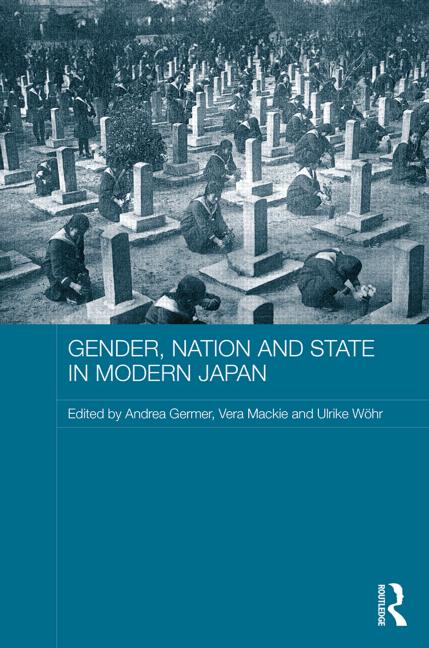
 Gender, Nation and State in Modern Japan
edited by Andrea Germer, Vera Mackie and Ulrike Wöhr, Routledge, 2014
Gender, Nation and State in Modern Japan makes a unique contribution to the international literature on the formation of modern nation–states in its focus on the gendering of the modern Japanese nation-state from the late nineteenth century to the present. References to gender relations are deeply embedded in the historical concepts of nation and nationalism, and in the related symbols, metaphors and arguments. Moreover, the development of the binary opposition between masculinity and femininity and the development of the modern nation-state are processes which occurred simultaneously. They were the product of a shift from a stratified, hereditary class society to a functionally-differentiated social body. This volume includes the work of an international group of scholars from Japan, the United States, Australia and Germany, which in many cases appears in English for the first time. It provides an interdisciplinary perspective on the formation of the modern Japanese nation–state, including comparative perspectives from research on the formation of the modern nation–state in Europe, thus bringing research on Japan into a transnational dialogue. This volume will be of interest in the fields of modern Japanese history, gender studies, political science and comparative studies of nationalism.
Contents
- Introduction: Gender, Nation and State in Modern Japan Andrea Germer, Vera Mackie and Ulrike Wöhr
- The Formation of Modern Imperial Japan from the Perspective of Gender Hayakawa Noriyo
- Narratives of Heroism in Meiji Japan: Nationalism, Gender and Impersonation Jason G. Karlin
- The Nexus of Nation, Culture and Gender in Modern Japan: The Resistance of Kanno Sugako and Kaneko Fumiko Mae Michiko
- Domestic Roles and the Incorporation of Women into the Nation State: The Emergence and Development of the ‘Good Wife, Wise Mother’ Ideology Koyama Shizuko
- The Making of Ainu Citizenship from the Viewpoint of Gender and Ethnicity Kojima Kyōko
- The Gendering of Work and Workers in the Process of Modernisation of the Textile Industry Himeoka Toshiko
- The Nation at Work: Gendered Working Patterns in the Taishō and Shōwa PeriodsRegine Mathias
- The Spirit to Take Up a Gun: Militarising Gender in the Imperial Army Sabine Frühstück
- Women’s Professional Expertise and Women’s Suffrage in Japan, 1868–1952 Sally Ann Hastings
- From Natalism to Family Planning: Population Policy and Its Reception During the War and the Postwar Period Ogino Miho
- From Mothers of the Nation to Embodied Citizens? Reflexive Modernisation, Women’s Movements and the Nation in Japan Ilse Lenz
- Gender and Citizenship in the Anti-Nuclear Power Movement in 1970s Japan Ulrike Wöhr
- Salaryman Anxieties in Tokyo Sonata: Shifting Discourses of State, Family and Masculinity in Post-Bubble Japan Romit Dasgupta
- Identity Politics, Gender and Nation in Modern Western Philosophy Sidonia Blättler
- From Personal Experience to a Political Movement in the 1970s: My View of FeminismIijima Aiko, with an Introduction by Andrea Germer

 What can I do with a B.A. in Japanese Studies?