
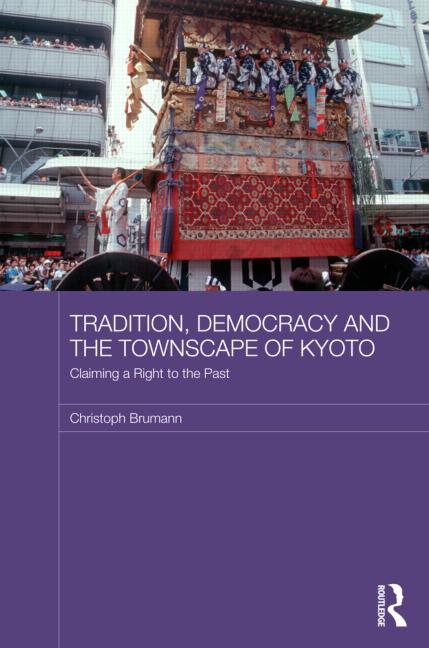
 As the historic capital of the country and the stronghold of the nation’s most celebrated traditions, the city of Kyoto holds a unique place in the Japanese imagination. Widely praised for the beauty of its townscape and natural environments, it is both a popular destination for tourists and home to one and a half million inhabitants. There has been a sustained, lively debate about how best to develop the city, with a large number of local government officials, citizen activists, urban planners, real-estate developers, architects, builders, proprietors, academic researchers, and ordinary Kyotoites involved in discussions, forming a highly peculiar social arena that has no match elsewhere in Japan.
This book, based on extensive fieldwork and interviews, provides an ethnographic study of this particular social field. It analyses how people in Kyoto deal with their most cherished traditions, such as the traditional town houses and the famous Gion matsuri festival, which calls into question several of the standard social scientific assumptions about the functions of cultural heritage for present-day societies. The book looks at the way concerned citizens, government bureaucrats, and other important players interact with each other over contentious modern buildings, often with the best intentions but constrained by set role expectations and by the superior power of national-level regulations and agencies. This book contributes to debates on the social uses of tradition and heritage, and the question of how to create sustainable, liveable urban environments.
“There are few greater conundrums than Kyoto, a city which combines what is most beautiful in Japan with what is also most ugly. Christoph Brumann’s superb ethnography of the process of town planning (and non-planning) and the interaction between the city authorities and its citizen groups explores this conundrum in a manner which has resonances not only for understanding the development of Japanese townscapes more widely but indeed the development of any modern city in the democratic world.”
Roger Goodman, University of Oxford“A theoretically informed, ethnographically rich and very well-written account of the tension between developing Kyoto and maintaining its unique heritage as a global historical city.”
Eyal Ben-Ari, Research Institute on Society, Security and Peace, Kinneret College on the Sea of Galilee
“This is. . .good ethnography. . .based on substantial periods of fieldwork. . . . Brumann witnessed some achievements of the citizens that will ensure Kyoto’s special place long into the future, during a time when some quite spectacular change was also taking place.”
Joy Hendry, Oxford Brookes University
“Under Brumann’s gaze, the city truly comes down to earth, as the author variously introduces the reader to the interactions of unscrupulous property developers, community activists, passive homeowners, consultant academics, low- and high-level bureaucrats, and even, as we come to find out, the researcher himself, as he pilots his way across a highly politicized landscape.. . .Brumann’s determination to look beyond his context and to de-Japanize Japanese culture is particularly steadfast.”
Bruce White, Doshisha University

 What can I do with a B.A. in Japanese Studies?