
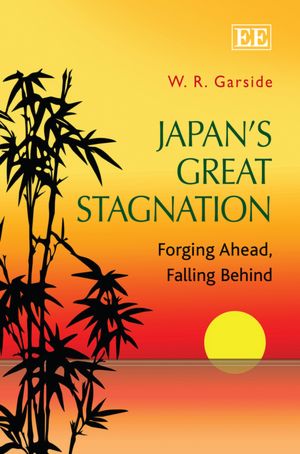
 W.R.Garside
Waseda University, Japan and University of Durham, UK
Edward Elgar Publishing, 2012
ISBN- 978-0-85793-821-3
This timely book presents a critical examination of the developmental premises of Japan’s high-growth success and its subsequent drift into recession, stagnation and piecemeal reform. The country, which within a few decades of wartime defeat mounted a serious challenge to American hegemony, appeared incapable of fully adjusting to shifting economic circumstance once the impulses of catch-up growth and the good fortune of an accommodating international environment faded.
Contents
Contents: Preface 1. Before Stagnation: Legacies of the High-growth Period 2. Catch-up Growth and Maturity: Developmentalism in Retrospect 3. Developmentalism as Ideology 4. Economic and Financial Policy in a Changing International Environment: The Origins and Course of the Bubble Economy 5. ‘Losing a Decade’: Economic and Financial Hubris in Recessionary Japan, 1990–97 6. Funding a Recovery: The Impact and Fate of Fiscal Policy, 1990–97 7. Banking Crises, Monetary Policy and Deflation, 1997–2000 8. Reform Without Salvation: Japan 1997–2000 9. Recession, Stagnation and the Labour Market: Continuity and Change in the 1990s 10. ‘Lost Decades?’ Japan’s Political Economy in the New Millennium Bibliography Index
‘Recent events have rendered Japan’s lost decades all the more relevant to the rest of us. Rick Garside, in this wide-ranging and accessible account, explores the political economy of Japan’s great stagnation with an eye toward describing how other advanced economies can avoid going down the same path.’
– Barry Eichengreen, University of California, Berkeley, US‘Professor Garside’s timely book transcends the national preoccupation suggested by its title. From one viewpoint this is a case study (admittedly on a grand scale) of the experience of one country in one historical period. But in analyzing the dynamic relationship between Japan’s post-war economic miracle and its chronic stagnation from the 1990’s he offers a penetrating insight into the links between profound and embedded institutional and ideological influences, global upheaval, and almost disastrous national economic performance. Hence, Japan’s Great Stagnation – the unfolding story of that country’s declining experience from masterful economic power to seeming economic paralysis – provides us with an all-too familiar scenario with which to approach the contemporaneous ills of the world’s developed economies. The interaction between banking crises, unwieldy institutions (especially, but not only, financial institutions), policy frailties, and stagnating demand – all conspired to create crisis and then handicap or prevent recovery. And the familiarity of the story is aggravated by the global financial crisis which now threatens to engulf us. History never fully repeats itself, but Professor Garside’s illuminating examination of Japan’s recent experiences must surely provide important points of relevance for the world’s current malaise. He is to be congratulated on the depth and scope of what he has achieved – and for its relevance to what we are experiencing.’
– Barry Supple, University of Cambridge, UK

 What can I do with a B.A. in Japanese Studies?