
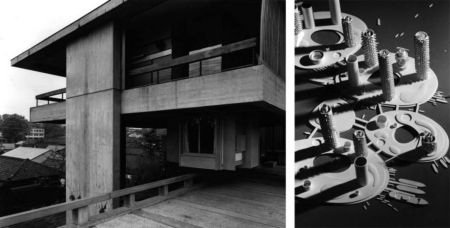
 Tectonic Visions Between Land and Sea: Works of Kiyonori Kikutake
On View: August 24 – October 17, 2012
Harvard Graduate School of Design
Gund Hall Lobby
48 Quincy Street
Cambridge, MA
http://www.gsd.harvard.edu/exhibitions
For more than half a century, visionary architect Kiyonori Kikutake (1928-2011) pursued Metabolic Architecture, embracing forces of renewal, recycling, and transformation. Following the debut of his own Sky House (1958) and Marine City (1958) at the 1959 C.I.A.M. Conference in Otterloo, Kikutake became a leading voice of Metabolism, the architectural movement launched at the 1960 World Design Conference in Tokyo, and then was further brought to an international stage at the New York Museum of Modern Art’s 1961 “Visionary Architecture” exhibition. Most recently, Rem Koolhaas has brought the Metabolist cause to contemporary discourse in his book, Project Japan (2011). For Kikutake, such transformative architecture built on the centuries-old tradition of wooden structures in Japan, and has continued to evolve with societal and technological changes up through the present.
As Kikutake’s first solo North American exhibition, the GSD display reexamines this seminal architect’s work in both its historical context and implications for the future within the context of a design school. The
exhibition will highlight the great scope of his work from the residential scale of the Sky House, public scale of the Izumo Administration Building (1963, 1980) and Hotel Tokoen (1964), to the urban scale of his ongoing Marine City project spanning from the late 1950s to the present. The display features original drawings, models, photographs and films that capture its tectonic construction, human-scaled spatial character, and change over time — most vividly embodied in the Sky House, which literally served as his platform for architectural discourse with architects from Louis Kahn and Peter Smithson up to Koolhaas. Kikutake’s work has been highly influential on subsequent generations –including disciples Toyo Ito, Itsuko Hasegawa, and Hiroshi Naito — and a whole new generation of young architects such that his vision lives on beyond his recent death according to cycles of continued metabolic change.
Ken Tadashi Oshima, guest curator
Dr. Oshima is associate professor in the Department of Architecture at the
University of Washington, Seattle and has been a visiting associate
professor at the Harvard GSD in 2012. Dr. Oshima’s publications include
GLOBAL ENDS: towards the beginning (Toto, 2012), Arata Isozaki (Phaidon,
2008) and International Architecture in Interwar Japan: Constructing Kokusai
Kenchiku (UW Press, 2009).
Related Events:
In conjunction with the Kikutake exhibition, the GSD Special Collections will present original documents highlighting the broader international context of Metabolism as an architectural movement and discourse intersecting with Harvard, its faculty and archival collections.
9/11 Discussion/Exhibition + Opening
6:30PM in Piper Auditorium, Gund Hall, GSD Harvard
Tectonic Visions between Land and Sea: Works of Kiyonori Kikutake
The exhibition examines the work of the visionary architect, a key figure in the “Metabolist” movement, launched in Tokyo in 1960. This panel discussion on the exhibition will feature the curator, Ken Tadashi Oshima (University of Washington, Seattle), Fred S. Thompson (Kikutake Architects 1062-64), Mark Mulligan(Harvard GSD), and Joan Ockman (Harvard GSD). A gallery talk/tour will follow.
10/16 Lecture
6:30PM in Piper Auditorium, Gund Hall, Harvard GSD
What Was Metabolism? Reflections on the Life of Kiyonori Kikutake
by Toyo Ito
The Metabolist Movement in the 1960s established the foundation from which contemporary architecture in Japan has emerged up to the present. Even today, the visionary architectural and urban projects created by the leading Metabolist Kiyonori Kikutake continue to shine brightly. In this lecture, Ito will consider Metabolism’s significance today through a rereading of his works of that time. Toyo Ito, Toyo Ito and Associates, Architects, Tokyo.

 What can I do with a B.A. in Japanese Studies?