
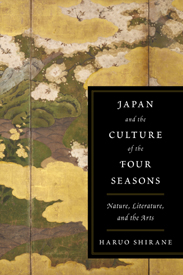
JAPAN AND THE CULTURE OF THE FOUR SEASONS
Nature, Literature, and the Arts
HARUO SHIRANE
“Japan and the Culture of the Four Seasons provides a compelling account of how Japan has appropriated, interpreted, and valued nature over the centuries. Shirane’s wide-ranging study tracks the culture of nature in Japan, and especially waka’s central role in constructing a vision of nature that impacted all the arts. In its breadth, depth, and accessibility, the book is of great value not only to scholars and students of Japan, but anyone interested in the intersections of art and nature.”
—Andrew M. Watsky, Princeton University
“A tour de force. Shirane synthesizes the long and complicated encoding of flora, fauna, toponyms and annual events of the Japanese landscape and calendar, untangling not only their synchronic connections, but also their historical development from the 8th to 19th century, from the nightingale (hototogisu) as a harbinger of summer in the Kokinshû to cats’ love-making as a topic for comic haikai verse in the Edo period. This book will be essential for anyone interested at all in virtually any genre of the traditional Japanese arts: poetry, costume, painting, noh theater, architecture, tea ceremony, flower arranging—or Japanese sweets (wagashi)!”
—Joshua Mostow, University of British Columbia
Elegant representations of nature, explicitly the four seasons, fill a wide range of Japanese genres and media—from poetry and screen painting to tea ceremony, flower arrangement, and annual observances. Haruo Shirane shows, for the first time, how, when, and why this occurred and explicates the richly encoded social, religious, and political meanings these representations embodied.
Refuting the long held belief that this phenomenon reflects agrarian origins, this book demonstrates how elegant representations of the four seasons first emerged in an urban environment among nobility in the eight century. They became highly codified and then spread to different social classes, eventually settling in popular culture and the pleasure quarters. Shirane accounts for all types of manifestations: textual (poetry, chronicles, tales), cultivated (gardens, flower arrangement), material (kimonos, screens), performative (noh drama, festivals), and gastronomic (tea ceremony, food rituals). He reveals how this kind of “secondary nature,” which flourished in Japan’s urban architecture and gardens, frequently fostered a sense of harmony with the natural world—just at the point at which it was receding. Eventually, alternative representations of nature derived from farm villages and elsewhere began to intersect with these elegant representations in the capital, creating a complex web of competing associations.
HARUO SHIRANE is Shincho Professor of Japanese Literature and Culture at Columbia University. He is the author and editor of numerous books on Japanese literature, including, Envisioning The Tale of Genji: Media, Gender, and Cultural Production; Traditional Japanese Literature: An Anthology, Beginnings to 1600; Early Modern Japanese Literature: An Anthology, 1600-1900; Classical Japanese: A Grammar; Traces of Dreams: Landscape, Cultural Memory, and the Poetry of Basho; and Bridge of Dreams: Poetics of the Tale of Genji.
COLUMBIA UNIVERSITY PRESS MARCH 2012 336 pages, 33 illus.
Order online: http://cup.columbia.edu/
Enter code: JAPSH for 30% discount
cloth 978-0-231-15280-8 regular price $29.50 now $20.65
Regular shipping and handling costs apply.

 What can I do with a B.A. in Japanese Studies?