
Modernism and Japanese Culture
By Roy Starrs. New York and London: Palgrave Macmillan, 2011, 344 pages.
Paperback: $25, Hardcover: $80.
Webpages: UK: http://www.palgrave.com/products/title.aspx?pid=360186; US:http://us.macmillan.com/modernismandjapaneseculture/RoyStarrs
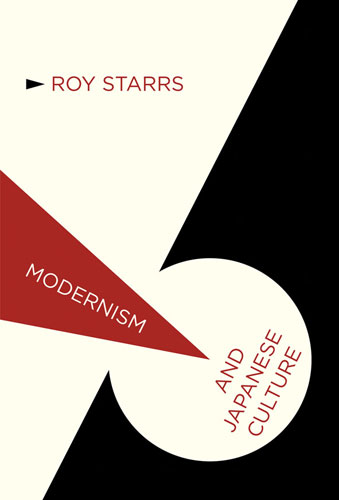
Offering an in-depth and comprehensive account of the complex history of Japanese modernism, in this book Roy Starrs considers the concept of modernism as encompassing not just the aesthetic avant-garde but a wide spectrum of social, political and cultural phenomena. He looks at Japanese modernism from the mid-19th century ‘opening to the West’ until the 21st-century, globalized world of ‘postmodernism’; from the early Meiji ‘cult of modernity’ to the early Showa attempt to ‘overcome modernity’. In this way, the book presents the history of Japanese modernism not as a straightforward, linear narrative of progressive acceptance and adaptation but more as a dialectical, back-and-forth oscillation between the two poles of acceptance and rejection, modernism and anti-modernism. Furthermore, Starrs shows that Japanese modernism was not simply the outcome of the passive reception of a unidirectional modern Western influence but of a complex cross-cultural interchange between East and West, modernity and tradition. In particular, he shows that traditional Japanese culture was very much part of that cultural mix, and a prime source of inspiration for modernists in both Japan and the West. Thus the book also convincingly demonstrates that Japan served as an active agent at certain key moments in the history of world modernism.
Politics and Religion in Modern Japan
Red Sun, White Lotus. Edited by Roy Starrs. New York and London: Palgrave Macmillan, 2011, 344 pages.
Webpages: UK: http://www.palgrave.com/products/title.aspx?pid=385916.
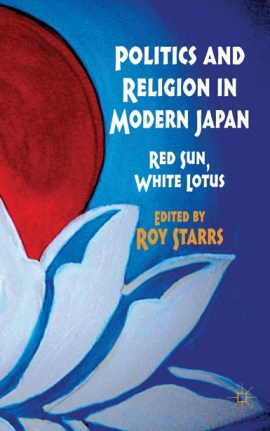
Politics and Religion in Modern Japan addresses crucial religious, socio-political and cultural issues raised by the troubled relationship between religion and the Japanese state from the mid-nineteenth century until the present day. It analyzes political dynamics of both of the two major Japanese religious traditions: the ‘red sun’ of national Shinto as well as the ‘white lotus’ of Buddhism. From a richly diverse range of disciplinary perspectives, the authors illuminate the overall history of modern Japanese political religion, while also focusing in depth on certain key moments and issues: the Meiji Restoration, the fascist 1930s, the postwar age of new religions, the Yasukuni Shrine controversy, and two major incidents of religiopolitical violence in late twentieth century Japan. The work will appeal to students and scholars of Japanese politics, religion, history, literature, and culture, as well as to anyone interested in the currently pressing topic of the relation between politics and religion in the modern world.
Rethinking Japanese Modernism.
Edited by Roy Starrs. Leiden and Boston: Brill, 2011, 549 pages. ISBN13: 9789004210035.
Webpage: http://www.brill.nl/rethinking-japanese-modernism
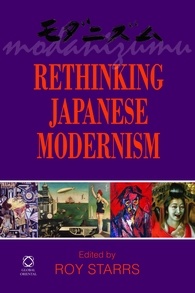 This collection of essays by an international group of leading Japan scholars presents new research and thinking on Japanese modernism, a topic that has been increasingly recognized in recent years to be key to an understanding of contemporary Japanese culture and society. By adopting an open, multidisciplinary, and transnational approach to this multifaceted topic, the book sheds new light both on the specific achievements and on the often-unexpected interrelationships of the writers, artists and thinkers who helped to define the Japanese version of modernism and modernity.
Specific topics addressed include the literary modernism of major writers such as Akutagawa, Kawabata, Kajii, Miyazawa, and Murakami, avant-garde modernism in painting, music, theatre, and in the performance art of Yoko Ono, and the everyday modernism of popular culture and of new urban activities such as shopping and sports.

 What can I do with a B.A. in Japanese Studies?